
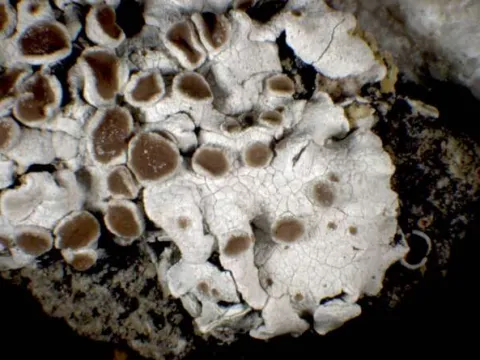
Squamarina lentigera
Squamarina lentigera
Squamarina lentigera is not a plant disease but rather a species of lichen that grows on the soil surface. It is a symbiotic organism consisting of a fungus and a photosynthetic partner (algae or cyanobacteria).
What the section contains
Squamarina lentigera
In agricultural contexts, it is often mistaken for a pathogen due to its crust-like growth on the ground. However, it does not infect plants, feed on plant tissue, or produce toxins that affect crop health.
The lichen belongs to the Stereocaulaceae family and typically features squamulose (scale-like) thalli that adhere closely to the substrate.
Since it lacks the mechanisms to colonize or penetrate live plant vascular systems, it is classified as an epigeic organism rather than a parasite.
Identifying this lichen as a "disease" is a common misconception, as its appearance is a biological reaction to specific soil chemistry rather than an infection cycle.
The growth of Squamarina lentigera is strictly governed by environmental factors, particularly the presence of calcareous or gypsiferous soils.
The species thrives in open, sunny habitats with low moisture content where it faces little competition from faster-growing vascular plants.
It acts as an indicator of ecological stability, as it is highly intolerant to industrial air pollution and frequent soil mechanical disturbance.
In environments where the soil surface remains bare for extended periods, the lichen can slowly colonize the substrate through vegetative fragmentation.
Seasonal fluctuations in rainfall and temperature directly impact its metabolic rate, leading to very slow colonization patterns in natural landscapes.
Squamarina lentigera poses no direct threat to agricultural crops as it does not parasitize them or extract nutrients from their root systems.
Potential indirect issues may arise when the lichen forms a dense crust, which could potentially limit the germination of small-seeded plants by hindering soil permeability.
In grazing lands, high densities of this lichen can reflect a lack of dense cover, which may be a sign of soil degradation or erosion in the long term.
- Physical crusting of the soil surface.
- Minor impact on the recruitment of native plant species in arid zones.
- Indicator of low nutrient turnover in the topsoil layer.
There is no economic damage associated with this lichen in crop production, making it irrelevant for standard pest management programs.
Standard control methods like fungicides are ineffective and unnecessary for Squamarina lentigera because it is not a pathogenic organism.
Management strategy should focus on improving soil health through appropriate crop rotation and the maintenance of a vigorous vegetation cover.
By increasing the competitive pressure from grasses and crops, the lichen is naturally shaded out, which effectively halts its expansion.
Sustainable land use practices, such as preventing overgrazing, ensure that the soil remains productive and covered by vascular plants rather than lichen crusts.
Proactive soil management is the best way to keep these lichen species at natural, non-invasive levels within an agricultural ecosystem.