
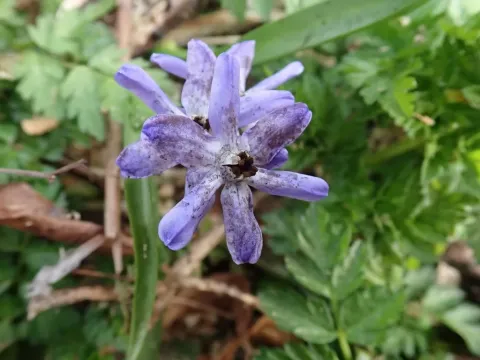
Squill smut
Antherospora scillae
The causative agent of this disease is a microscopic fungus Antherospora scillae, belonging to the order Ustilaginales (smut fungi).
What the section contains
Squill smut
This pathogen is a highly specialized parasite that primarily attacks the reproductive organs of plants belonging to the Asparagaceae family.
The fungus develops directly inside the anther tissues, gradually replacing the healthy pollen with a mass of its spores.
The life cycle of the pathogen is closely linked to the phenology of the host plant, allowing it to successfully overwinter inside the bulb or in the soil.
Spore dispersal occurs mainly through wind, insect pollinators, or by physical contact between infected and healthy plant parts.
The main external symptom of the disease is the deformation and discoloration of the plant's anthers.
Instead of healthy yellow pollen, a dark, dusty mass of fungal spores forms inside the flower buds.
Flowers of infected plants often appear stunted, and their petals may wither prematurely or fail to open fully.
When an anther is dissected, a characteristic "smutty" coating is observed, which is easily dispersed upon the slightest mechanical disturbance.
Infection may not be apparent immediately and often becomes visible only during the active flowering period of Scilla and related species.
The development of Antherospora scillae is directly dependent on air humidity and temperature during the spring season.
Cool and wet weather at the beginning of the vegetation period creates ideal conditions for spore germination and tissue penetration.
Overcrowded bulbous plantings facilitate faster spread of the infection from one plant to another.
Poor ventilation and moisture stagnation in the planting area significantly increase the risk of mass infestation by this fungus.
The inoculum persists in the soil, making it impossible to grow susceptible crops on the same site for several years.
The primary damage caused by the disease is the total loss of the reproductive capacity of the infected plants.
Because the anthers are completely replaced by spores, seed reproduction becomes impossible, and the pollen loses its viability.
Fungal infection leads to general weakening of the plant, making it more susceptible to secondary infections.
The aesthetic value of Scilla plantings is significantly reduced as flowers lose their characteristic appearance and degrade prematurely.
In nursery conditions, the disease can lead to the rejection of a high percentage of planting material and significant economic losses.
The main preventive method is the thorough selection of healthy planting material before storage.
Upon detection of the first signs of the disease, infected specimens must be immediately removed by the root and destroyed.
Crop rotation is recommended, with a waiting period of at least 3-4 years before planting bulbous crops on affected sites again.
To prevent spore dispersal, avoid overwatering and ensure good soil and plant aeration.
When necessary, apply fungicidal treatments to the soil and bulbs using systemic products approved for ornamental crops.