
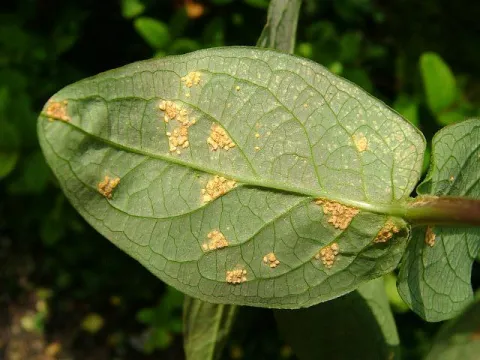
St. John's wort rust
Melampsora hypericorum
The causative agent of the disease is the fungus Melampsora hypericorum, an obligate parasite of the rust family. It specializes in infecting members of the Hypericum genus by colonizing their aerial parts.
What the section contains
St. John's wort rust
The fungus reproduces through spores, which are disseminated by wind, rain, and insects. Its life cycle involves the formation of uredinia and telia, which appear as pustules on the leaves and stems of the host plant.
Once the spores land on a susceptible plant, they penetrate the epidermis and develop a network of hyphae within the leaf tissue. This network extracts nutrients from the plant's living cells, leading to physical damage.
The fungus survives the winter primarily in the form of dormant teliospores present on dead plant debris. These spores germinate in the spring to start the cycle of primary infection again.
Because the fungus is highly host-specific, it thrives where St. John's wort is grown continuously, making crop rotation and sanitation vital strategies for preventing outbreaks.
The earliest sign of infection is the emergence of small, bright yellow or orange spots on the underside of the leaves. These are pustules filled with urediniospores that easily rub off upon contact.
As the infection progresses, these pustules can merge, covering significant portions of the leaf surface. The leaves typically turn yellow, curl at the edges, and become brittle before dropping prematurely.
Stems also show symptoms, manifesting as elongated, rusty-colored lesions. These lesions disrupt the plant's vascular system, hindering the transport of water and nutrients to the upper parts of the plant.
In advanced cases, the tissue around the pustules becomes necrotic, turning dark brown or black. The overall vigor of the plant declines, and it may fail to produce healthy flowers or seeds.
- Bright orange or rust-colored powdery pustules on leaves.
- Premature yellowing and shedding of foliage.
- Stunted stem growth and necrotic lesions on stems.
High humidity and cool to moderate temperatures are the primary drivers of Melampsora hypericorum development. Frequent rainfall and persistent dew promote spore germination and infection.
Optimal temperatures for the fungus range from 15 to 22 degrees Celsius. During periods of wet weather within this temperature range, the disease can spread rapidly throughout a field.
Crowded planting schemes are particularly hazardous, as they create a stagnant microclimate with poor airflow. This humidity trap allows the rust fungus to thrive and propagate efficiently.
Lack of sanitation in the field provides a continuous source of inoculum. If infected debris remains on the ground, the risk of early-season infection for the next year's crop is significantly increased.
Excessive nitrogen fertilization can lead to lush, soft plant tissue, which is structurally more vulnerable to fungal penetration compared to well-balanced, hardened plant tissue.
The primary economic impact of the rust is the loss of harvestable quality. Since St. John's wort is a medicinal herb, leaves covered in fungal spores or necrotic patches are unacceptable for pharmaceutical processing.
By damaging the leaves, the fungus significantly reduces the plant's photosynthetic capacity. This leads to a decrease in the concentration of active compounds, such as hypericin, reducing the medicinal value of the herb.
The disease weakens the plants, making them more susceptible to cold damage during winter and reducing the overall lifespan of the crop, which is crucial for a perennial plant.
If left unmanaged, the rust can cause a severe reduction in plant biomass. This results in direct economic losses and may necessitate the clearing and replanting of entire affected fields.
Furthermore, an infected field acts as a constant threat to neighboring healthy crops, as windborne spores can travel long distances to infect other St. John's wort patches.
Sanitation is the cornerstone of control. Removing and destroying all infected plant residues after harvest is essential to break the fungal life cycle and reduce the spore load for the following season.
Strategic planting, including wide spacing and proper orientation, is necessary to improve air circulation and reduce the humidity levels that favor rust development in the foliage.
When necessary, fungicides approved for use on medicinal herbs may be applied. These should be used as part of an integrated pest management strategy to minimize chemical residue on the harvested product.
Encouraging strong plant growth through balanced phosphorus and potassium fertilization helps the plant build natural structural defenses against fungal hyphae.
Regular scouting of the fields during the growing season allows for the early detection of the disease, enabling immediate removal of infected plants to limit the spread of the fungus.