
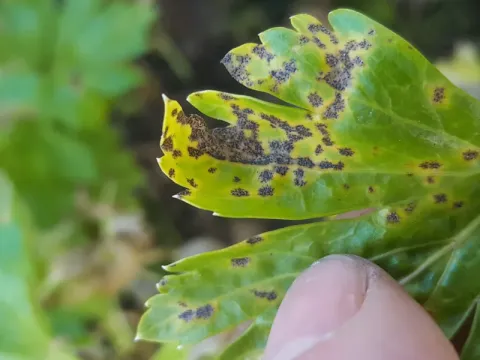
Celery Septoria blight
Septoria apiicola
The causal agent of celery Septoria blight is the fungus Septoria apiicola, a pathogen that specifically attacks celery and related species within the Apiaceae family.
What the section contains
Celery Septoria blight
The fungus produces small, black, flask-shaped fruiting bodies known as pycnidia, which are embedded in the necrotic tissues of the leaves and stems.
Inside these pycnidia, countless spores are produced and released under moist conditions, allowing the pathogen to spread rapidly throughout the crop.
The pathogen can survive as mycelium or pycnidia in infested crop debris left in the field and is frequently transmitted via contaminated seeds.
Once introduced to a field, the disease can become established and persist for several years if proper sanitation and rotation practices are not strictly followed.
Initial symptoms include the appearance of small, yellow-green spots on the leaves, which eventually turn brown or grey as the tissue dies.
The most diagnostic feature is the presence of numerous tiny black dots within the spots; these are the pycnidia that are easily visible with a magnifying lens.
As the infection progresses, spots may merge, causing extensive necrosis on the leaf surface and leading to premature yellowing and drying of the foliage.
Stems and petioles can also be affected, displaying elongated lesions that may weaken the plant and lead to tissue rot under high humidity.
In severe cases, the entire plant may appear blighted, stunted, and withered, significantly reducing the vigor and overall health of the crop.
Septoria blight development is highly dependent on moisture; the disease thrives in cool to moderate temperatures ranging from 15°C to 20°C.
Prolonged wet weather, including continuous rainfall, heavy dew, and high humidity, provides the necessary moisture for spores to germinate and infect host tissues.
Poor field ventilation, often caused by high planting density or lack of weeding, creates a humid microclimate that accelerates the spread of the fungus.
Splashing water from overhead irrigation or heavy rain acts as the primary mechanism for dispersing spores from lower infected leaves to the upper canopy.
Favorable conditions for the disease can occur throughout the growing season, necessitating constant monitoring of the field during rainy periods.
The economic impact of Septoria blight is significant, primarily due to the loss of leaf mass which is crucial for the plant's photosynthetic process.
For growers of celery, the disease compromises both the aesthetic appearance of the produce and its marketability, leading to severe economic losses.
The stunted growth of the plants results in smaller yields and can make the roots or stalks more susceptible to secondary rot during storage.
Heavy infestations can lead to a total loss of the crop in the field if protective measures are not implemented early in the development cycle.
In addition to yield loss, the cost of managing the disease through intensive fungicide applications increases the total production expenditure.
Management starts with the use of certified, disease-free seed and treating seeds with hot water or fungicides to eliminate potential internal infections.
Effective crop rotation is essential; avoid planting celery or other susceptible crops in the same area for at least three to four years to break the infection cycle.
Field sanitation is critical: remove and destroy all crop residues after harvest to minimize the primary inoculum available for the next season.
Chemical control involving regular fungicide applications is often required, particularly during wet seasons or in areas where the disease is historically prevalent.
- Utilize disease-resistant celery cultivars.
- Improve air circulation through optimal plant spacing.
- Implement drip irrigation to avoid wetting the leaves.
- Regularly monitor fields and remove the first symptomatic leaves to reduce the spread.