
Cellypha goldbachii
Cellypha goldbachii
Description
Symptoms
The initial symptoms manifest as small, whitish or cream-colored spots or film-like growths that localize on the lower parts of stems or leaf sheaths.
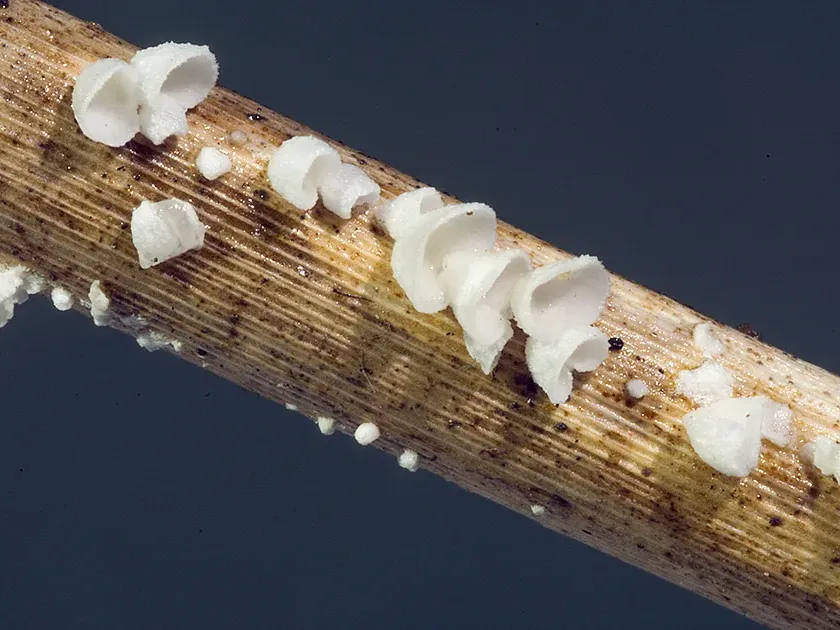
As the disease progresses, small cup-shaped or flattened fruiting bodies emerge on the affected surfaces, appearing firmly attached to the plant substrate.
Tissues at the site of infection gradually lose their color and structural integrity, becoming brittle and prone to necrotic lesions as the fungus consumes the cellular contents.
Affected plants often show signs of general stunted growth, yellowing of the lower leaves, and premature wilting due to the impairment of vascular transport systems.
Microscopic examination of the affected tissue reveals the characteristic structure of the fungal fruiting bodies, which serves as the diagnostic marker for this pathogen.
Pathogen
The causal agent of this condition is the fungus Cellypha goldbachii, which belongs to the basidiomycetes group and primarily targets various herbaceous plants, specifically grasses.
This pathogen often follows a saprotrophic lifestyle, living on dead or decaying plant tissue, but it can transition to a parasitic role under conditions that weaken the host plant.
The fungal mycelium invades the epidermal tissues of the plant, degrading structural components and absorbing nutrients necessary for its own metabolic processes and growth.
Its life cycle involves the formation of specialized fruiting bodies that release spores, allowing the fungus to propagate efficiently through wind or water splashes across the field.
The fungus is capable of surviving for long periods on plant debris, maintaining an inoculum source that can threaten subsequent crops in the next growing season.
Conditions for development
The development of Cellypha goldbachii is heavily dependent on high humidity and the presence of surface moisture, such as dew or rain, which are essential for spore germination.
Moderately cool weather during the spring or early autumn provides the optimal temperature window for rapid mycelial expansion and infection of host plants.
High planting density, which restricts airflow and prevents the crop from drying out after precipitation, creates a microclimate highly conducive to the spread of the fungus.
Accumulation of non-decomposed plant residues on the soil surface acts as a primary reservoir for the pathogen, fueling its spread to young, susceptible seedlings.
Plant stress, caused by nutrient deficiencies, poor soil conditions, or previous mechanical damage, significantly lowers the plant's resistance to colonization by the fungus.
Why it matters
The primary economic impact of the disease is a significant reduction in crop yield, resulting from the physiological disruption of the plant's growth and development.
Weakening of the stems can lead to increased lodging, which not only stunts further development but also makes harvesting operations difficult and inefficient.
The infection negatively impacts grain quality and weight, leading to a decrease in the overall marketability and economic value of the harvested agricultural product.
Localized patches of dying plants reduce overall stand density, creating voids in the field that limit the yield potential of the entire area.
The long-term hazard involves the progressive build-up of the fungal inoculum in the soil, which necessitates intensive management strategies in future cropping cycles.
Protection
Effective management begins with proper crop rotation, which breaks the pathogen's life cycle by eliminating the host plants required for its survival.
Deep plowing and incorporation of crop residues into the soil facilitate the rapid decomposition of the fungus's habitat, significantly reducing the inoculum load.
Providing a balanced nutrient program strengthens the plant's internal defenses, allowing it to better withstand fungal pressure throughout the growing season.
Fungicide application may be required in high-risk areas or during seasons with abnormally high rainfall to protect the crop from severe infection outbreaks.
- Optimizing planting density to ensure proper canopy aeration.
- Utilizing disease-resistant or tolerant crop varieties.
- Managing weed populations that may host the pathogen.
Discussion
No discussions yet — be the first.