
Cellar fungus
Coniophora puteana
Description
Symptoms
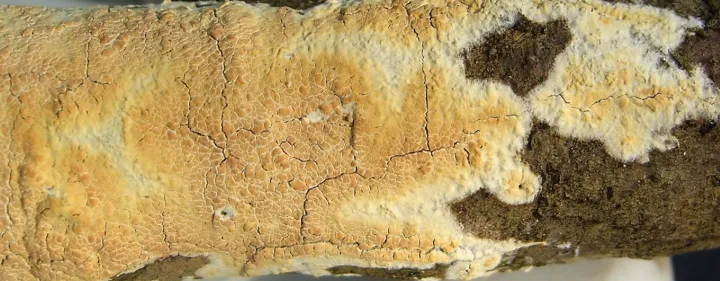
Initial indicators include thin, yellow-to-brownish mycelial strands or sheets forming on the wood surface.
As the rot progresses, the wood darkens significantly, often appearing brownish or charcoal-colored in advanced stages.
The characteristic sign of brown rot is the cube-shaped cracking pattern of the wood, known as cubical fracturing.
When dry, the affected wood crumbles easily into a fine powder or small, brittle fragments when rubbed.
Fruiting bodies may appear as flat, olive-green to dark brown crusts, often found in dark, damp areas.
Pathogen
The causal agent of this disease is the basidiomycete fungus Coniophora puteana, which is classified as a brown rot fungus.
This pathogen specifically targets the cellulose and hemicellulose components of wood, leaving the lignin mostly untouched.
The fungus produces a widespread mycelium that can travel across non-nutritive surfaces to reach new wood sources.
It is one of the most common and destructive agents affecting timber in buildings, as well as wood in natural forest environments.
Reproduction is primarily achieved through basidiospores, which facilitate rapid spread throughout damp environments.
Conditions for development
The cellar fungus requires high moisture levels in the wood, typically exceeding 30-40 percent, to thrive and colonize effectively.
It prefers temperate conditions and is highly active in environments with poor ventilation and stagnant, humid air.
The fungus is highly resilient and can colonize various types of wood if the conditions for moisture accumulation are met.
Direct contact with damp concrete or soil is a common pathway for the fungus to enter wooden floor joists and supports.
Lack of proper air circulation in basements and crawl spaces creates an ideal microclimate for the development of the fungal colonies.
Why it matters
The primary threat posed by Coniophora puteana is the rapid loss of structural integrity in wooden components.
Buildings can suffer severe damage to floor joists, staircases, and roof trusses, potentially leading to dangerous structural failure.
Because the decay often happens internally, the wood may appear sound on the surface while being severely weakened inside.
The fungus spreads quickly through moist structures, meaning that a small initial infection can compromise an entire building if left untreated.
Economic damage includes the cost of replacing large amounts of structural timber and the labor involved in remediation.
Protection
Prevention focuses on moisture control, which is the most effective way to inhibit the growth of wood-decay fungi.
Ensuring proper ventilation in all parts of a building prevents the accumulation of the moisture required for fungal survival.
Applying borate-based wood preservatives or other professional-grade fungicides provides a strong barrier against future colonization.
- Regular inspections of wood in high-risk areas, such as bathrooms and basements.
- Removing all damp or decaying wood and disposing of it away from the property.
- Installing vapor barriers to separate wood from damp foundations or soil surfaces.
If decay is discovered, affected wood must be removed and replaced with pressure-treated lumber to prevent recurrence.
Discussion
No discussions yet — be the first.