
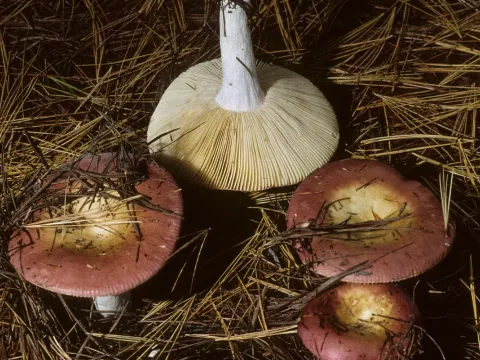
Wine-red brittlegill
Russula vinosa
It is important to emphasize that Russula vinosa (Wine-red brittlegill) is biologically not a plant disease, but a basidiomycete fungus from the Russulaceae family.
What the section contains
Wine-red brittlegill
This species does not possess parasitic properties in relation to agricultural crops or forest tree species.
It is not a pathogen, as it belongs to a group of mycorrhizal fungi that live in symbiosis with the roots of woody plants.
In phytopathological reference books, this fungus is never classified as a pathogen that causes necrosis, rot, or wilting.
Misclassification often occurs due to the visual resemblance of fruiting bodies to certain leaf spots, but the organism's genetic nature precludes infection of plant tissues.
Mycelium development occurs exclusively through symbiotic relationships with coniferous species, primarily in damp forest soil conditions.
The emergence of fruiting bodies requires high substrate humidity and the presence of specific forest litter components enriched with organic matter.
Optimal temperatures for mycelium formation and subsequent mushroom growth range from +15 to +22 degrees Celsius.
The fungus prefers acidic soils typical of pine and spruce forests, where it exchanges mineral nutrients for carbohydrates provided by the host tree.
Spore dispersal occurs via air currents; however, they cannot germinate on living agricultural crop tissues due to the lack of enzymatic machinery required to degrade plant cell walls.
The Wine-red brittlegill poses absolutely no threat to agronomic crops, vegetables, cereals, or fruit trees.
Conversely, the presence of such fungi in the rhizosphere of forest stands indicates a healthy state of the biocenosis and adequate nutrient intake for tree roots.
This species is incapable of producing toxins that suppress the growth of neighboring plants, so agricultural measures for its eradication are unnecessary.
The lack of harmfulness is confirmed by years of mycological research, classifying this species as a food object rather than a phytopathogen.
Farmers should not confuse this fungus with pathogenic species that cause root rot, as Russula vinosa does not compromise the integrity of plant tissues.
Since Russula vinosa is not a disease, no control or prevention measures are required regarding this object.
If fungi are found in a garden or field, their presence should be viewed as an indicator of natural biological soil balance.
The use of fungicides against mycorrhizal fungi is excessive and potentially harmful, as it disrupts beneficial soil microflora.
If the presence of mushrooms is undesirable for decorative reasons, it is sufficient to physically remove the fruiting bodies without using chemical treatments.
Prevention in this context is not required, as the object does not pose a risk to agricultural productivity or economy.