
Witches broom disease of cacao
Crinipellis
Description
Symptoms
The hallmark symptom is the proliferation of distorted, broom-like shoots that have thickened internodes and are unable to produce healthy leaves.
These broom structures grow at an accelerated rate initially but become brittle and eventually turn necrotic, providing a base for the development of fungal fruiting bodies.
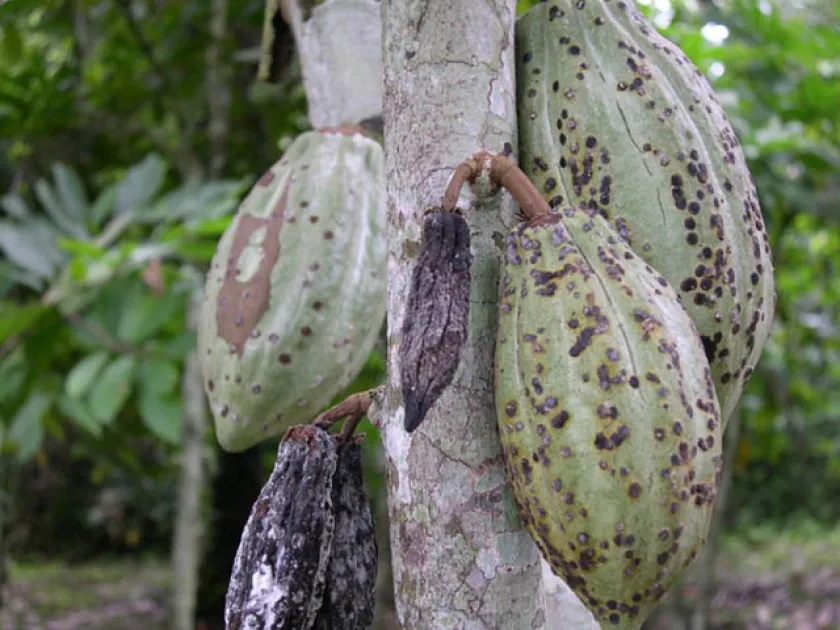
Infected floral cushions produce malformed flowers that fail to set fruit, or if fruit is set, the pods become hard, black, and misshapen.
Inside the cacao pods, the fungus colonizes the developing seeds, leading to internal rotting and rendering the crop commercially useless.
Small, pinkish-brown mushroom-like structures develop on the dead branches and pods, serving as the primary source for further spore dissemination.
Pathogen
The disease is caused by the basidiomycete fungus Crinipellis perniciosa (also classified as Moniliophthora perniciosa), which is highly specialized for infecting cacao trees.
The fungus operates as a hemibiotroph, alternating between a biotrophic phase, where it feeds on living plant tissues, and a necrotrophic phase that kills host tissue.
During the necrotrophic stage, the fungus produces toxins that cause tissue necrosis and subsequent structural collapse of the affected plant parts.
Infection begins when basidiospores land on susceptible meristematic tissues like young shoots, flower cushions, or developing fruit pods in the presence of surface moisture.
The fungal mycelium colonizes the intercellular spaces of the plant, disrupting natural growth regulators and leading to the typical symptoms associated with the disease.
Conditions for development
Fungal infection and spore germination are strictly dependent on environmental moisture, requiring free water on the plant surface to initiate the disease process.
Tropical climates with high humidity levels and frequent rainfall create the optimal environmental framework for the fungus to thrive and spread throughout a plantation.
The optimal temperature range for the development of the pathogen is approximately +20°C to +25°C, which is consistent with year-round cocoa-growing conditions.
Poor plantation management, such as dense spacing and lack of pruning, prevents adequate airflow and keeps the canopy environment moist, promoting fungal growth.
Wind and water droplets are the primary vectors for spore dispersal, allowing the pathogen to move rapidly between trees in an orchard setting.
Why it matters
Witches broom disease is globally recognized as one of the most destructive threats to cacao production, capable of destroying up to 90% of the annual yield.
Beyond crop loss, the disease weakens the tree's physiological structure, causing stunted growth, decreased lifespan, and eventual death of the entire plant.
The economic devastation includes reduced export revenues, high costs for constant orchard sanitation, and the potential need to abandon plantations entirely.
Regional cocoa industries have faced collapse in areas where the disease is established, severely impacting the livelihoods of millions of smallholder farmers.
The disease significantly lowers the quality of any harvested beans, making them unsuitable for processing into high-grade chocolate or cocoa products.
Protection
The most effective management strategy is the rigorous and frequent removal of diseased tissues through sanitary pruning to lower the overall pathogen load.
Breeding and planting genetically resistant cacao cultivars remain the most sustainable long-term solution to managing the impact of the disease.
Chemical control using copper-based fungicides can be utilized, but success relies on strict application timing during the susceptible stages of tree growth.
Improved orchard management, including proper tree spacing and weeding, helps maintain a drier microclimate that is less conducive to spore germination.
- Implementing strict quarantine protocols for imported plant material.
- Continuous monitoring and scouting for early signs of infection.
- Exploring biological control agents, such as hyperparasitic fungi.
Discussion
No discussions yet — be the first.