
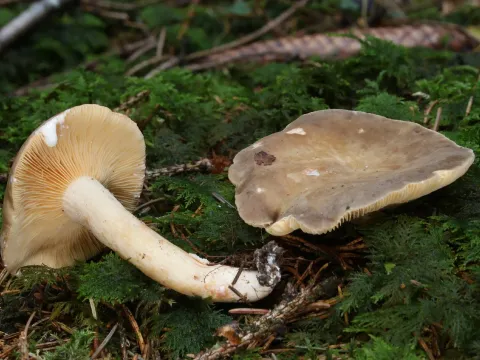
Wing-spored milkcap
Lactarius pterosporus
The wing-spored milkcap (Lactarius pterosporus) is a species of fungus in the family Russulaceae. It is essential to clarify that this organism is not a plant pathogen and does not cause plant diseases.
What the section contains
Wing-spored milkcap
Biologically, it is a mycorrhizal fungus that forms symbiotic relationships with woody plants. It does not infect plant tissues as a parasite but instead creates an ectomycorrhizal connection.
The fungus develops primarily in symbiosis with broad-leaved tree species, most commonly beech (Fagus) and occasionally oak (Quercus).
This species is not responsible for any agricultural or forest diseases. Its mycelium interacts with the tree's root system, forming a mantle that aids in the absorption of water and minerals.
The scientific classification and identification of this fungus are based on the morphology of its fruiting bodies and the characteristic wing-like ridges on its spores.
The fruiting bodies emerge from forest litter as medium-sized gilled mushrooms. The cap typically features a funnel shape with an ochre-brown or yellowish-tan hue.
A diagnostic feature is the presence of latex (milk) that exudes when the gills or flesh are damaged. The latex is initially white but turns pinkish or reddish upon exposure to air.
The gills are crowded and decurrent on the stem, showing a yellowish color that also bruises to a pinkish-brown tone when handled.
The stem is solid initially and becomes hollow with age; it is colored similarly to the cap and often has a pruinose texture near the top.
The spore print is creamy. Under microscopic examination, the spores display ridges forming a reticulum that resembles wings, which is a key identifying trait.
Optimal development conditions are linked to the presence of mature broad-leaved forests where a stable fungal network is established.
The fungus prefers moderately moist soils rich in humus and organic litter. Mycelial development requires constant nutrient exchange with host trees.
The temperature range for fruiting corresponds to the moderately warm conditions found during the summer and autumn months in temperate forest zones.
An important factor is the presence of undisturbed leaf litter, which protects the mycelium from desiccation and sudden temperature fluctuations.
This species is not found in agricultural fields or areas with intensive soil cultivation, as the destruction of the symbiotic link with trees leads to the death of the mycelium.
This species poses no threat to agriculture or forestry. It acts as a natural and beneficial component of forest ecosystems.
There is no harm associated with this fungus, as it lacks the properties of a pathogen that would damage timber or affect crops.
On the contrary, its presence in the woods is an indicator of soil health and the proper functioning of the mycorrhizal associations of trees.
Its economic value is negligible, as it is considered inedible or of low quality for consumption due to the acrid taste of its latex.
Therefore, from an agronomic perspective, it is treated as a neutral mycorrhizal organism that requires no protective or control measures.