
Septobasidium tanakae
Septobasidium tanakae
Description
Symptoms
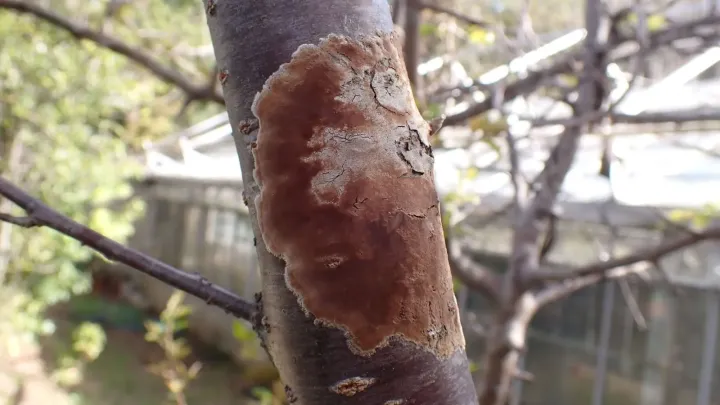
The primary diagnostic sign of this infection is the formation of fungal mats on tree trunks and branches. These mats vary in color from light brown to greyish, often displaying a leather-like texture.
The surface of these growths is typically felt-like or crusty. Close observation under these fungal mats will reveal the presence of scale insects, which are essential for the fungus to establish itself.
Infected branches may exhibit localized growth retardation. The bark beneath the fungal coverage may appear rough or irregularly deformed, distinguishing it from the healthy areas of the tree.
The disease is most prevalent on perennial woody plants. Affected areas often develop in clusters, following the distribution pattern of the insect colonies that the fungus exploits.
The mats can expand over time, potentially encircling a branch. During the dormant season, when the trees have shed their leaves, these structures are most noticeable to an observant gardener.
Pathogen
The pathogen Septobasidium tanakae is a fungus classified within the Basidiomycota phylum. This fungus is biologically distinct due to its obligate symbiotic relationship with scale insects that reside on the bark of woody host plants.
The fungus develops visible, leathery mats on the surface of the bark. These mats serve as a protective cover for the colonies of scale insects, which provide the fungus with metabolic secretions and nutrients required for its growth.
This parasitic complex relies on the life cycle of the scale insects, as the crawlers assist in spreading the fungal spores to new, healthy branches. Consequently, the disease is commonly found in areas where scale populations are high.
While the fungal mycelium blankets the bark, it typically does not penetrate deep into the woody tissue. However, it creates a physical barrier that impacts the normal respiratory processes of the bark surface.
The fungus is able to overwinter in its mycelial form within the protective mats on the tree bark, ensuring its persistence in the garden environment from one season to the next.
Conditions for development
High humidity and moderate temperatures are the most critical environmental factors for the success of Septobasidium tanakae. Dense, poorly ventilated tree canopies provide an ideal microclimate for the pathogen.
The presence of scale insects is the absolute prerequisite for the disease. Without these insects, the fungus cannot thrive or colonize the tree effectively, as the symbiosis is essential for its life cycle.
Warm, rainy weather facilitates the production and dissemination of spores via water droplets and wind. These spores easily spread to adjacent branches, leading to the rapid expansion of the infection throughout the tree.
Neglected orchards with poor sanitation practices are more susceptible to this disease. Lack of routine pruning creates a favorable environment for both the insects and the fungal growth.
The optimal temperature for fungal growth is generally between 18 and 25 degrees Celsius, matching the seasonal peak of scale insect activity.
Why it matters
The main damage caused by the disease is the inhibition of the bark's respiratory function. By physically covering the surface, the fungal mats restrict air exchange, leading to gradual branch weakening.
The cumulative effect of the scale insect feeding and the presence of the fungus places significant physiological stress on the plant. This weakens the tree's immune system, making it vulnerable to secondary pests.
Over time, the infection can cause localized dieback of branches. This leads to a substantial decrease in fruit yield and negatively impacts the overall health and longevity of the woody host.
Persistent infestations compromise the structural integrity of the bark, creating entry points for other opportunistic pathogens or wood-boring insects, which can further damage the tree.
Economically, this disease increases maintenance costs, as specialized interventions are required to manage both the insect vectors and the fungal growth simultaneously.
Protection
Effective management begins with controlling the scale insect population. Using systemic insecticides during the crawler stage is crucial to disrupting the symbiosis that sustains the fungus.
Sanitary pruning to remove and destroy heavily infected branches is necessary to reduce the inoculum level in the garden. Removed material should be burned to prevent further spread.
Dormant sprays, particularly copper-based fungicides applied in late winter or early spring, help to sanitize the bark and reduce the viability of fungal spores.
Improving canopy airflow through strategic pruning creates an unfavorable environment for the disease. Reducing humidity within the canopy is a simple yet effective preventative measure.
- Systemic insecticide treatments targeting scale insects.
- Sanitary pruning and burning of infested wood.
- Application of copper-based fungicides during tree dormancy.
- Regular canopy thinning to improve aeration and light penetration.
- Monitoring trees for early symptoms of fungal mat formation.
Discussion
No discussions yet — be the first.