
Septobasidium scale
Septobasidium pedicillatum
Description
Symptoms
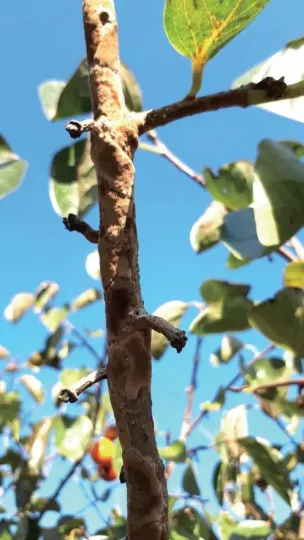
The primary symptom of the disease is the development of dense, leathery, or felt-like fungal mats that adhere firmly to the tree bark.
These growths typically appear greyish-brown to yellowish-tan in color, often resembling lichen patches but with a more uniform and dense fungal structure.
The fungus develops primarily on the exterior of the bark, forming mycelial cords that connect the colony to the underlying scale insect population.
During dry weather, the fungal crust may become brittle and crack, potentially exposing the scale insects sheltered beneath the mycelial cover.
A distinctive feature of this disease is its constant association with scale insects, which the fungus protects as part of a complex symbiotic relationship.
Pathogen
The causative agent of the disease is the fungus Septobasidium pedicillatum, a member of the basidiomycetes group.
This pathogen exhibits a symbiotic lifestyle, as it cannot thrive without the presence of scale insects, which provide the necessary nutrients and substrate.
The fungal mycelium is perennial, allowing the organism to survive throughout the year and persist on the tree bark across different seasons.
Reproduction occurs via basidiospores, which are disseminated by wind and water droplets to colonize new parts of the tree or adjacent plants.
The fungus creates a physical shield, effectively protecting the scale insects from chemical treatments and natural predators.
Conditions for development
Disease development is highly dependent on warm, humid environments, commonly occurring in regions with mild winters and high rainfall.
Dense tree canopies that lack sufficient airflow and light penetration create a favorable microclimate for the rapid growth of the fungus.
Older trees with rough, flaky, or damaged bark provide ideal attachment points for the fungal spores to establish and begin colonization.
High populations of scale insects are a prerequisite for the disease, as the fungus relies heavily on their presence for successful development.
Extended periods of fog or high humidity are essential for the germination of spores and the continued expansion of the fungal mat on the bark surface.
Why it matters
The fungus harms the tree by obstructing the bark's natural respiratory processes, which can stress the plant's vascular system over time.
By protecting scale insects, the fungus indirectly promotes the damage caused by these pests, such as sap-sucking and subsequent loss of tree vigor.
Affected trees may show significantly reduced shoot growth, chlorosis, and, in severe cases, the premature shedding of leaves.
Continued infestation often leads to the dieback of infected branches, which can permanently deform the tree canopy and reduce overall fruit yield.
The presence of the fungus weakens the tree's natural defenses, making it more susceptible to secondary fungal or bacterial infections.
Protection
Management involves a dual approach, targeting both the fungal growth with fungicides and the scale insect population with systemic or contact insecticides.
Early spring or late autumn applications of copper-based fungicides are highly effective at cleaning the bark and suppressing the fungus.
Sanitary pruning of heavily infected branches, followed by their immediate removal and destruction, is essential to prevent further spread.
Mechanical bark cleaning, such as gentle brushing of the trunk, can help remove accumulated mycelium and expose scale insect hiding spots.
Proper orchard management, including thinning of the canopy to improve air circulation, creates an environment less conducive to fungal proliferation.
Discussion
No discussions yet — be the first.