
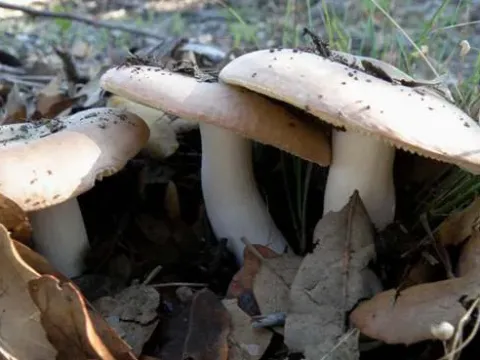
Dawn brittlegill
Russula aurora
The dawn brittlegill (Russula aurora) is a gilled mushroom characterized by a distinctive rosy-pink to orange-red cap, often featuring a yellowish center.
What the section contains
Dawn brittlegill
Its gills are typically pale cream or light ochre in color, which serves as a key identification feature to distinguish it from other Russula species.
The stem is white, cylindrical, and firm when young, but becomes characteristically brittle as the mushroom matures, reflecting its classification.
The flesh has a mild, pleasant taste without any acrid odor, making it a well-regarded species for those foraging in forest environments.
It is crucial to clarify that this species is not a plant disease but a beneficial organism within its ecosystem.
The dawn brittlegill is not a plant pathogen; labeling it as a "disease" is scientifically incorrect and misleading.
It functions primarily as a mycorrhizal fungus, forming a mutually beneficial symbiotic relationship with the root systems of trees.
Biologically, Russula aurora is a member of the Basidiomycota division, which lacks the machinery to infect or damage living plant tissue.
Instead of attacking plants, the fungus aids in nutrient and water absorption, enhancing the overall vigor of its host trees.
There are no documented cases where this species acts as an infectious agent in agriculture or forestry.
Growth of the dawn brittlegill depends heavily on the presence of suitable host trees and a healthy, undisturbed forest floor.
Adequate soil moisture and moderate temperatures are essential for the mycelium to produce fruit bodies, typically during the summer and autumn.
The species prefers slightly acidic to neutral soils with a rich layer of organic matter, common in mature forest stands.
In highly cultivated agricultural soils, the fungus rarely develops due to the disruption of the delicate fungal-root networks.
Environmental stability, including the absence of excessive chemical inputs, is important for the survival of this fungus.
There is no economic or agricultural harm associated with the dawn brittlegill as it does not parasitize crops or trees.
Its presence is considered an indicator of ecological health rather than a sign of pathological disturbance or infection.
The fungus does not cause rot, wilting, or any necrosis, ensuring that surrounding vegetation remains unaffected by its growth.
No agricultural losses are attributed to this species, as it provides ecological services rather than causing biological damage.
Consequently, it poses zero threat to commercial farming operations or silvicultural interests.
No control measures are necessary, as the dawn brittlegill is not a pest or a causative agent of plant disease.
The application of fungicides in areas where this fungus thrives is unnecessary and potentially detrimental to the soil microbiome.
Management strategies focus on maintaining forest health and biodiversity, where mycorrhizal fungi are encouraged to persist.
Agronomic guidelines involve distinguishing between beneficial forest fungi and actual pathogens to avoid mismanaged chemical use.
General observation of such fungi is recommended for researchers interested in monitoring forest ecosystem stability.