
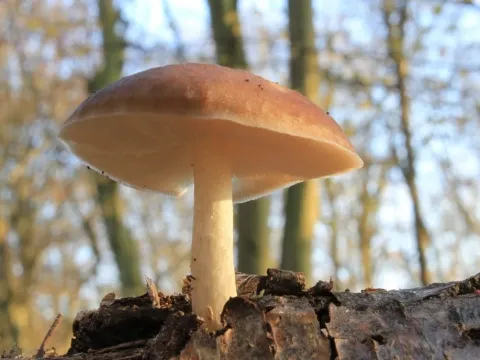
Deer mushroom
Pluteus cervinus
The deer mushroom (Latin: Pluteus cervinus) is a typical saprotrophic fungus belonging to the Pluteaceae family. Unlike parasitic fungi, this species is not an infectious agent for living agricultural crops.
What the section contains
Deer mushroom
Biologically, this organism acts as a wood-decaying fungus (xylotroph). It does not affect growing plants; therefore, classifying it as a "plant disease" in an agronomic sense is incorrect, as it functions as a decomposer in forest communities.
The causative agent of wood decay is the fungus mycelium, which actively penetrates dead plant tissue. It utilizes enzymatic systems to break down lignin and cellulose contained in dead trees.
The fungus develops on decaying residues of broadleaf trees. Its life cycle is closely linked to the destruction of organic matter in ecosystems, which is critical for the natural nutrient cycle in nature.
Mycological classification places this object among higher basidiomycetes. It lacks pathogenicity towards grain, vegetable, or fruit crops, and therefore, does not require control measures in agricultural production.
The main sign of the fungus presence is the appearance of fruiting bodies on stumps, fallen logs, or heavily damaged dead wood. The cap diameter ranges from 5 to 15 cm, and the color varies from grayish-brown to dark brown.
The gills of the mushroom are free, initially white, and turn a characteristic pinkish hue as the spores mature. This is an important diagnostic feature that distinguishes the deer mushroom from many other xylotrophic species.
The stem is firm, fibrous, often curved, white or yellowish in color, and up to 10–12 cm long. The absence of a ring on the stem is a morphological feature of this species.
The flesh of the fruiting body is white, does not change color when cut, and has a distinct odor of fresh radish or raw potatoes. These features allow for accurate identification of the object in the field.
- Cap diameter: 5–15 cm.
- Gill color: white to pink.
- Growth pattern: solitary or in small groups on wood.
- Odor: distinct, vegetable-like.
- Spore print: pinkish-brown.
Optimal conditions for fungal development include high substrate moisture and moderate temperatures. It is most active during periods of prolonged rainfall, from late spring until late autumn.
The deer mushroom prefers substrates with a moderate acidity level. It is most commonly found on the stumps of oak, beech, birch, and other broadleaf trees that are in the active stage of decay.
The fungus can withstand short-term temperature fluctuations; however, stable high relative humidity in the root zone of the wood is critical for the formation of fruiting bodies.
The fungus mycelium can remain in a latent state inside the wood for a long time, waiting for favorable conditions to release spores. The process of substrate colonization occurs gradually as the tree tissues die off.
In agroecosystem conditions, if old stumps or uncleaned wood debris are present on the site, the fungus may develop actively without causing harm to surrounding agricultural plants.
The deer mushroom poses no threat to agricultural crops. It is not a phytopathogen and is incapable of penetrating the tissues of living plants, as it lacks mechanisms to overcome the immunity of cultivated species.
The main economic significance of the fungus lies in its participation in organic mineralization processes. It accelerates the decomposition of woody debris, preparing the soil for subsequent use as fertilizer.
In specific cases, such as when using wood as a building material or as supports for trellised crops, this fungus can contribute to the biodeterioration of structures upon contact with the soil.
Thus, the harmfulness of the fungus is limited to its ability to break down dead wood. For a live garden or field, it acts more as a scavenger than a pest.
Misinterpreting the fungus as a plant "disease" is often caused by confusion between saprotrophic species and parasites capable of causing decay in living plant tissues.
Specialized protection measures (fungicidal treatments) against the deer mushroom are not applied, as the object is not a pathogen of agricultural crops.
To prevent excessive spread of the fungus on a site, timely removal of old stumps, rotten branches, and other wood debris that serves as a nutrient medium is recommended.
If it is necessary to preserve wooden supports for plants (e.g., in vineyards), antiseptic wood impregnation should be used to prevent colonization by the fungal mycelium.
Maintaining good drainage on the site reduces the moisture of the surface soil layer and wood, making the conditions less suitable for the active development of fungal fruiting bodies.
No chemical preparations intended for the control of late blight or other plant diseases are effective or required to destroy this species in an agroecosystem context.