
Deadly Webcap
Cortinarius orellanus
Description
Symptoms
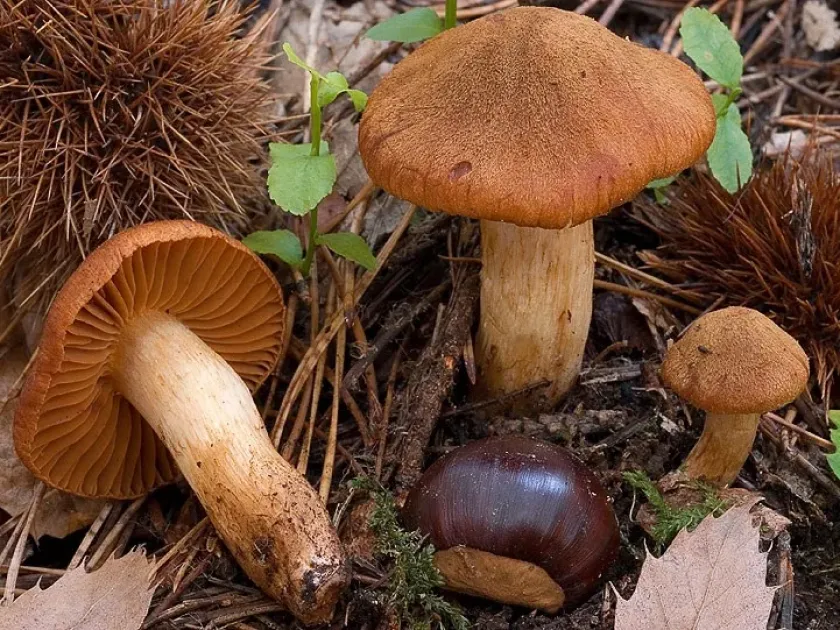
The fruit body features a distinct cap up to 8 cm in diameter, colored in shades of rusty-brown or orange-red.
The cap surface is finely fibrous or scaly, with a blunt umbo (hump) in the center, which serves as a key identifying characteristic for the species.
The gills are spaced, broad, and attached with a notch, colored in ochre-rusty tones that match the color of the cap and stem.
The stem is cylindrical or slightly club-shaped, fibrous, dense, and lighter in color than the cap, often bearing remnants of the veil.
The flesh of the mushroom is yellowish or light brown, possessing a faint smell of radish, which is quite distinct from other mushroom aromas.
Pathogen
It is crucial to state that Cortinarius orellanus (Deadly Webcap) is not a plant disease or a pathogen of agricultural crops. It is a basidiomycete fungus belonging to the Cortinariaceae family.
This mushroom mainly lives in a mycorrhizal association, forming symbiotic relationships with the roots of deciduous and coniferous trees, primarily occurring in forest environments.
The fungus mycelium develops in leaf litter and soil, interacting actively with the tree root systems, making it a component of the forest ecosystem rather than an agricultural pest.
Biologically, the species is characterized by the presence of specific toxins known as orellanins, which pose a severe risk if ingested by humans.
Unlike phytopathogens, this fungus does not cause rot, necrosis, or wilting in plants, so classifying it as a plant disease is factually incorrect.
Conditions for development
Active fruiting of this species occurs from late summer to mid-autumn when soil moisture levels in forest habitats are optimal.
It prefers acidic soils and is found in mixed and deciduous forests, often associating with beech, oak, or birch trees to form mycorrhiza.
The fungus favors shady and humid locations where a layer of leaf litter helps maintain a stable microclimate for mycelium development.
The temperature range for fruit body development is limited to moderate values, as sudden frosts interrupt the reproductive cycle of the fungus.
Spore dispersal occurs via air currents, allowing the fungus to colonize new areas of forest soil where suitable host trees are present.
Why it matters
The main danger of this object lies in its extreme toxicity to humans, as it contains orellanin, a deadly nephrotoxin.
These toxins attack the kidneys with a very long incubation period, which complicates timely diagnosis and emergency medical intervention.
For agricultural crops, the mushroom poses no threat as it does not parasitize vegetables, grains, or fruit crops grown in commercial fields.
Risks for agronomists and forest workers are strictly limited to accidental ingestion or misidentification while visiting forest zones near farmland.
Any attempts to eradicate this fungus from the soil are unnecessary, as it is a natural part of the forest biocenosis and does not interfere with modern agronomy.
Protection
Protective measures in the agricultural sense are not required, as the Deadly Webcap does not affect cultivated plants and is not a subject of phytosanitary control.
The main preventive strategy involves increasing personnel awareness regarding edible and poisonous mushrooms to avoid accidental poisonings.
If these mushrooms are found on areas adjacent to agricultural sites, access should be restricted to prevent amateur foragers from picking them.
The use of fungicides against this fungus is strongly discouraged, as it would disrupt soil microbial balance and damage beneficial tree mycorrhiza.
Public education on the specific morphological traits of this species remains the most effective way to prevent human health incidents.
Discussion
No discussions yet — be the first.