
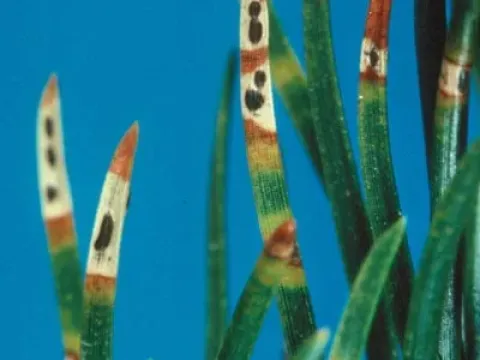
Davisomycella asiatica
Davisomycella asiatica
The primary symptom of this infection is the premature yellowing and browning of pine needles, leading to significant needle cast.
What the section contains
Davisomycella asiatica
Small, elongated fruit bodies of the fungus (apothecia) appear on the surface of the needles, usually arranged along the central vein.
Affected trees exhibit sparse crowns, particularly in the lower canopy, where the microclimate is more conducive to fungal growth.
In later stages of the disease, the needles become necrotic and brittle, causing them to fall off well before their natural lifespan ends.
Visual identification is most effective during the growing season when the contrast between healthy green foliage and infected needles is clear.
The disease is caused by the fungus Davisomycella asiatica, a specialized ascomycete pathogen that targets various pine species.
The fungus completes its life cycle by infecting fresh needles, where it develops mycelium within the internal leaf tissues.
Reproduction involves the release of ascospores from apothecia, which are disseminated by wind and rain splashes during wet periods.
The pathogen utilizes the stomata of the needles as entry points, facilitating colonization and subsequent tissue damage.
The survival strategy of this fungus includes overwintering on fallen pine needles, ensuring a recurring source of inoculum for the next spring.
High humidity and consistent rainfall are the primary environmental drivers for the development and spread of this fungal pathogen.
Densely planted forests with restricted airflow maintain higher moisture levels, significantly increasing the risk of infection.
The pathogen flourishes in environments where pine needles remain wet for extended periods, allowing spores to germinate and infect successfully.
Poorly managed sites with excessive ground litter provide a reservoir for the fungus, perpetuating the disease cycle year after year.
Climate factors such as prolonged damp springs are particularly dangerous, as they coincide with the vulnerability of newly flushing needles.
The most significant harm is the depletion of the tree's photosynthetic capacity due to the loss of its primary needle foliage.
Reduced photosynthesis leads to stunted growth, weakened vigor, and increased susceptibility to secondary pests and environmental stress.
In nursery settings, the pathogen can cause significant economic loss by rendering young seedlings unsuitable for transplantation.
In mature forest ecosystems, chronic infection weakens the tree's overall defense mechanisms, making it prone to opportunistic pathogens.
The cumulative effect of annual needle loss can eventually lead to the decline and death of trees that have been severely compromised.
Sanitation is a critical control measure; removing and destroying infected fallen needles helps to reduce the primary inoculum load.
Promoting good forest hygiene through selective thinning improves air circulation and helps the canopy dry faster after rainfall.
Fungicide applications, when managed correctly in nurseries, are effective at protecting seedlings during the peak infection windows.
Selecting and planting pine species that show natural resistance to fungal pathogens is a sustainable strategy for long-term forest management.
Regular surveillance programs are essential for detecting early signs of the disease and implementing containment strategies promptly.