
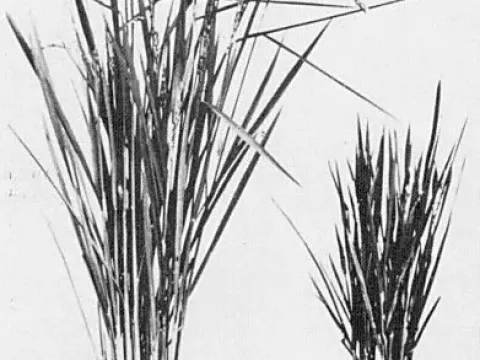
Rice ragged stunt
Rice ragged
The primary symptom of Rice ragged stunt is the severe stunting of plants, giving them a dwarfed appearance compared to healthy crops in the field.
What the section contains
Rice ragged stunt
A distinctive feature is the presence of ragged or uneven leaf margins, which are often deformed, twisted, or curly in texture.
The leaves of infected plants typically display a dark green color, and upon closer inspection, translucent galls or swellings can be seen along the veins.
Infected plants often exhibit delayed maturity and failure of the panicles to emerge fully from the leaf sheath, leading to significant yield loss.
Many of the resulting panicles are sterile, bearing few or no grains, as the virus disrupts the normal reproductive physiology of the rice plant.
The disease is caused by the Rice ragged stunt virus (RRSV), which belongs to the genus Oryzavirus and the family Reoviridae.
The viral genome consists of segmented double-stranded RNA, a structure that provides stability within the host tissue throughout the infection cycle.
The virus is transmitted by the brown planthopper (Nilaparvata lugens), which acts as a vector in a persistent, circulative manner.
The virus undergoes multiplication inside the insect vector, meaning the planthopper remains infectious for the remainder of its lifespan after acquisition.
There is no evidence of seed transmission or mechanical transmission via field equipment; the planthopper is the essential link for the disease cycle.
Outbreaks of the disease are closely associated with the population density of the brown planthopper, which thrives in warm and humid climates.
Irrigation practices that maintain constant high humidity within the crop canopy favor the proliferation of the planthopper vectors.
The availability of alternative host grasses and ratooning rice plants between cropping seasons provides a reservoir for the virus to survive year-round.
High nitrogen fertilization rates can encourage dense plant growth, which creates an ideal microclimate and food source for the vector population.
The disease spreads most rapidly during periods of high rainfall followed by warm temperatures, which stimulate both crop growth and vector movement.
Rice ragged stunt is considered a high-impact disease, capable of causing devastating reductions in crop yields in endemic regions.
Early-stage infections are particularly damaging, often resulting in total failure of the plant to produce any grain or biomass for harvest.
The viral infection reduces the plant's ability to withstand other environmental stresses, such as water deficit or soil nutrient imbalances.
Farmers face significant financial losses due to crop failure and the recurring costs of pesticide applications intended to suppress vector populations.
In addition to grain losses, the quality of the rice straw is often compromised, reducing its value as livestock feed or organic fertilizer.
The most effective strategy for disease management is the deployment of rice varieties that exhibit genetic resistance to the virus or the vector.
Integrated Pest Management (IPM) practices, including the timely use of targeted insecticides, are essential to keep brown planthopper populations below economic thresholds.
Sanitation measures, such as clearing weeds and destroying crop stubble, are vital to eliminate viral reservoirs and vector breeding grounds.
Optimizing planting schedules to avoid overlapping with peak migration periods of the planthoppers can significantly reduce the incidence of infection.
- Use of certified, healthy seed stocks.
- Synchronized planting within a community to disrupt pest cycles.
- Regular field scouting for early symptoms of stunting.
- Avoidance of excessive nitrogen applications.