
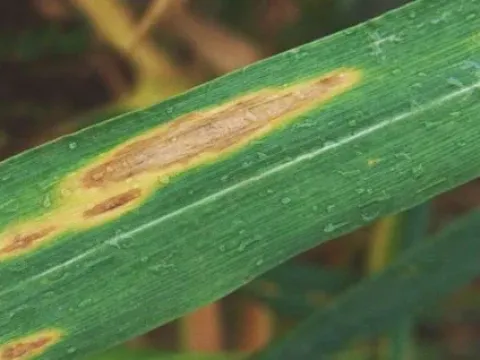
Tan spot
Pyrenophora nobleae
The causal agent of tan spot is the fungus Pyrenophora nobleae. It is an ascomycete pathogen known for causing significant damage to wheat crops by infecting leaves and stems.
What the section contains
Tan spot
The fungus overwinters in the form of pseudothecia on infected crop residues left on the soil surface. In the spring, these structures produce ascospores that are released into the air, initiating the primary infection cycle.
Once the initial infection is established, the fungus produces conidia, which serve as secondary inoculum throughout the growing season. These spores are wind-dispersed and facilitate the rapid spread of the disease under suitable conditions.
The fungus colonizes plant tissues by penetrating the epidermis and releasing specialized phytotoxins. These toxins are responsible for the chlorotic and necrotic symptoms observed on infected wheat leaves.
The pathogen shows high adaptability, allowing it to survive in various environments. Its complex life cycle, involving both sexual and asexual stages, makes it a persistent threat in continuous wheat cropping systems.
Tan spot symptoms typically appear as small, tan-colored lesions on the leaves. As the infection progresses, these lesions expand into distinct, oval-shaped spots, often surrounded by a characteristic yellow halo.
If conditions are favorable for disease development, multiple spots may coalesce, leading to large necrotic areas on the leaf surface. This loss of green tissue significantly impairs the plant's photosynthetic capacity.
Under high humidity, a fine, grayish mold may become visible on the lesion surfaces, representing the fungal sporulation layer. In advanced stages, the infected leaves dry out and die prematurely.
While the leaves are the primary sites of infection, the pathogen can also affect leaf sheaths and occasionally the stem. Severe infections at the flag leaf stage are particularly detrimental to grain filling.
The disease usually starts in the lower canopy and moves upwards as the season progresses, driven by rain splashes and wind-borne spores.
The development of Pyrenophora nobleae is heavily dependent on moisture. Prolonged periods of leaf wetness, such as heavy dew or frequent rainfall, are critical for spore germination and infection.
Temperatures ranging from 15°C to 25°C create an optimal environment for the fungus to multiply and spread. While it can survive higher heat, rapid epidemic development requires moderate temperatures combined with humidity.
Conservation tillage practices, which leave wheat straw on the soil surface, provide an ideal reservoir for the fungus. Without the breakdown of these residues, the inoculum load remains high year after year.
Dense crop stands can create a humid microclimate within the canopy, facilitating the spread of spores. Poor air circulation in these stands significantly increases the risk of severe infection.
Irrigated wheat fields, especially those using overhead sprinkler systems, are prone to higher levels of tan spot due to the consistent leaf wetness provided by the irrigation cycle.
The primary damage caused by tan spot is the reduction of green leaf area, which decreases the plant's ability to produce assimilates during grain filling. This directly impacts yield potential.
In addition to lower grain yields, the quality of the grain is often compromised. Infected wheat may show reduced grain weight, lower test weight, and poor protein content, affecting marketability.
The weakening of the plant makes it more susceptible to opportunistic secondary infections, including root rot and other fungal diseases. This leads to a decline in overall plant health and resilience.
Early defoliation caused by the disease can accelerate crop maturity, resulting in shriveled kernels and reduced harvest efficiency. The overall economic impact is a combination of direct yield loss and increased costs for fungicides.
In severe cases, if the flag leaf is heavily damaged during the grain-filling stage, the loss in crop value can be substantial, sometimes exceeding 30-40% of the harvest.
Effective management begins with crop rotation. Rotating wheat with non-host crops like legumes or oilseeds is the most efficient way to break the disease cycle and reduce inoculum levels.
Cultural practices such as deep tillage to bury crop residues are highly effective. Incorporating stubble into the soil accelerates decomposition and eliminates the primary source of overwintering pseudothecia.
Fungicide application during the growing season is the standard chemical control. Products containing triazoles, strobilurins, or SDHI inhibitors are effective if applied at the correct timing relative to symptom development.
Using resistant or tolerant wheat varieties is a key component of an integrated pest management strategy. Selecting cultivars with high resistance can significantly reduce the need for fungicide treatments.
- Regular monitoring of fields to detect early symptoms.
- Ensuring adequate soil nutrition to boost plant vigor.
- Removing volunteer wheat plants that act as green bridges.
- Optimizing seeding rates to allow for better air circulation.