
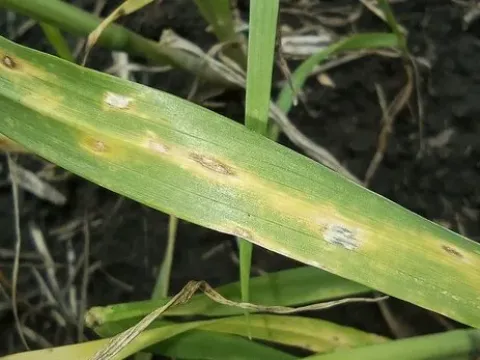
Tan spot of cereals
Pyrenophora catenaria
The disease is caused by the fungus Pyrenophora catenaria, which primarily infects various species of cereals during the growing season.
What the section contains
Tan spot of cereals
The pathogen survives the winter as mycelium and pseudothecia within the residues of previously infected cereal crops left on the field.
In spring, the fungus produces conidia that are disseminated by wind and rain splashes to new susceptible leaves of growing plants.
This pathogen possesses high adaptability to different environmental conditions, making it a persistent challenge in cereal production.
The infection process is complex and involves the secretion of host-specific toxins that cause the characteristic necrosis observed on the leaves.
Initial symptoms consist of small, dark brown spots that gradually enlarge as the infection progresses through the leaf tissue.
A distinct chlorotic halo, often described as a yellowing of the tissue, surrounds the necrotic spot due to the fungal toxin release.
As the disease advances, individual spots may coalesce, leading to significant portions of the leaf tissue becoming necrotic and dying.
Under humid conditions, a greyish mould may appear on the lesions, indicating active spore production by the fungus.
- Lesions are often oval-shaped or elongated.
- Premature yellowing and drying of the foliage.
- Increased severity in the lower canopy moving upwards.
High relative humidity and frequent rainfall are the primary factors that promote the development and spread of the disease.
Temperatures ranging between 15°C and 25°C are considered optimal for the rapid infection and progression of the fungus.
Monoculture farming practices significantly increase the risk by maintaining a continuous reservoir of inoculum in the field.
Poor ventilation within dense crop stands creates a microclimate that remains humid for longer periods, favoring fungal proliferation.
Prolonged leaf wetness duration is critical for the germination of spores and successful penetration of the leaf cuticle.
The primary economic impact is the reduction of green leaf area, which severely limits the plant's ability to perform photosynthesis.
This leads to reduced grain weight, poor grain filling, and an overall decrease in the quantity and quality of the final cereal yield.
In severe cases of infection occurring during the grain-filling stage, yield losses can be substantial, often exceeding 25 percent.
Weakened plants are also more susceptible to secondary stressors, including drought and infestation by other opportunistic pathogens.
Increased operational costs arise from the need for repeated fungicide applications to manage the disease throughout the growing season.
Crop rotation is essential to break the disease cycle by removing the host source for the fungus for at least two years.
Effective management of crop residues through tillage encourages decomposition and limits the survival of fungal inoculum.
The application of systemic fungicides at the appropriate growth stages provides effective protection against disease development.
Growing resistant or tolerant cereal varieties is a fundamental strategy to minimize damage and reduce dependency on chemicals.
Maintaining balanced soil fertility helps plants strengthen their natural defenses and recover more effectively from environmental stress.