
Fescue leaf spot
Pyrenophora grahamii
The fungus Pyrenophora grahamii is the causal agent of this leaf spot disease, commonly affecting various species of fescue (Festuca).
What the section contains
Fescue leaf spot
Its anamorph, Drechslera dictyoides, produces conidia that serve as the primary inoculum for spreading the disease during the growing season.
The pathogen is known to persist in crop debris, infested seeds, and soil, remaining viable under various environmental conditions until the host is available.
As an ascomycete fungus, it utilizes both sexual and asexual reproduction cycles to ensure its survival and spread within the field.
Host colonization involves the production of enzymes that break down plant cell walls, allowing the fungus to establish itself within the leaf tissues.
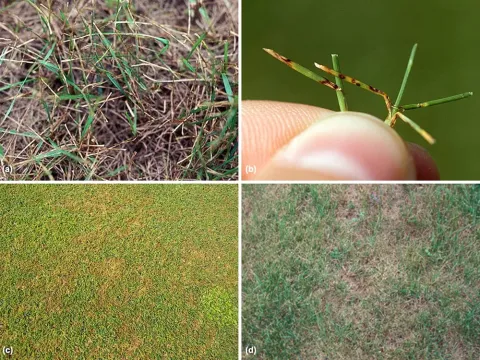
Early symptoms typically appear as small, chlorotic flecks that develop into dark brown or black spots with distinct irregular shapes.
The spots are often net-like in appearance because the lesions are restricted by the leaf veins, creating a characteristic cross-hatched pattern.
As the disease advances, lesions enlarge and coalesce, resulting in widespread chlorosis and necrosis of the leaf blades.
Under high humidity, a velvety layer of olive-black fungal spores may develop on the surface of the lesions, marking the active sporulation phase.
While the disease primarily affects leaves, severe infections can cause the foliage to wither prematurely and significantly reduce the overall greenness of the sward.
Disease development is highly favored by moderate temperatures ranging from 15°C to 22°C, which are typical for active grass growth.
High relative humidity and prolonged leaf wetness, caused by dew, rain, or irrigation, are essential for the germination of fungal conidia.
Poor field drainage and excessive plant density create stagnant air conditions that significantly increase the risk of rapid disease spread.
Plants under nutrient stress or those experiencing unfavorable soil conditions are more susceptible to infection by Pyrenophora grahamii.
The fungus is particularly aggressive in regions or seasons where cool, moist conditions prevail for extended periods.
The reduction in green leaf area impairs photosynthesis, which leads to stunted plant growth and decreased biomass production.
Forage quality is negatively affected, as infected grass may have reduced protein content and lower palatability for livestock.
Severe infestations can lead to thinning of the stand, reducing the productive lifespan of pastures and requiring costly reseeding efforts.
Seed production is also jeopardized, as the disease can cause shriveled seeds and lower overall harvest yields.
Economic damage is cumulative, involving loss of yield, degraded fodder quality, and increased expenditure on disease management practices.
Effective management begins with the use of certified disease-free seeds and the selection of resistant fescue cultivars.
Sanitation practices such as the removal or deep incorporation of crop residues help to significantly reduce the primary inoculum load.
Proper pasture management, including rotational grazing and timely mowing, helps prevent the build-up of moisture and fungal spores in the canopy.
Maintaining balanced soil fertility, particularly adequate nitrogen and potassium levels, helps plants better withstand the pressure of fungal pathogens.
- Regular monitoring of fields for initial symptoms.
- Application of authorized fungicides if conditions favor an epidemic.
- Improvement of drainage systems to prevent waterlogging.
- Avoidance of over-seeding to ensure good air circulation.