
Field blewit
Lepista personata
Description
Symptoms
The primary indicators of its presence are the fruit bodies (mushrooms) that emerge during the autumn season in fields, meadows, or gardens.
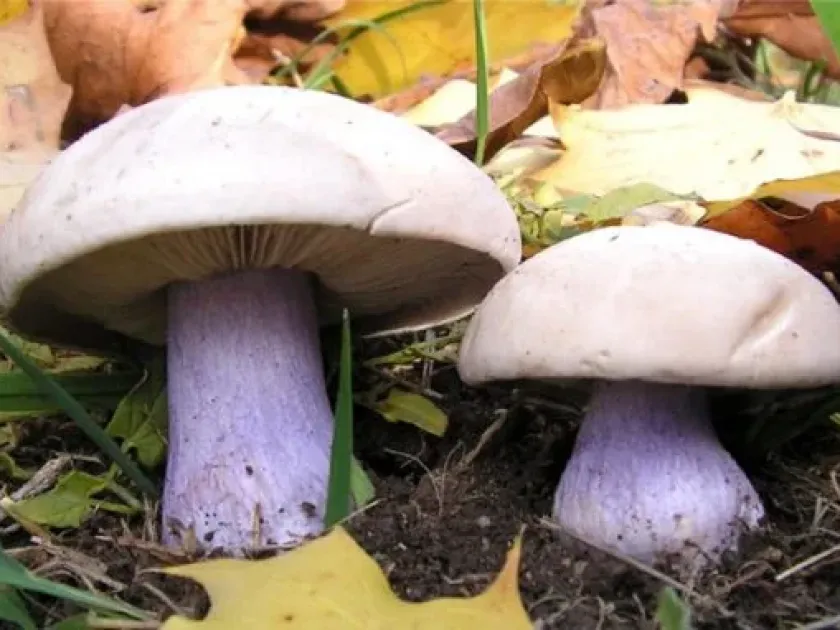
The cap typically displays shades of grayish-brown to beige and is generally smooth, often becoming convex with age.
The defining diagnostic feature of this species is the stalk, which exhibits a distinct violet or lilac coloration, justifying its name.
The gills underneath the cap are crowded and can range in color from whitish to yellowish as the mushroom matures.
Underground, the mycelium may form large rings or arcs, commonly known as fairy rings, which are visible in grassy areas.
Pathogen
The field blewit, scientifically known as Lepista personata (syn. Clitocybe saeva), is a basidiomycetous fungus belonging to the Tricholomataceae family.
It is crucial to clarify that this fungus is not a plant pathogen or a disease agent that harms living tissues of agricultural crops.
Instead, Lepista personata functions as a saprotroph, specifically a litter-decomposing fungus that thrives on organic matter in the soil.
Unlike parasitic fungi that invade crops, this organism plays a beneficial role in natural and agricultural ecosystems by breaking down dead plant material.
Its mycelium extensively colonizes the top layer of soil, facilitating the mineralization of complex organic compounds into nutrients for plants.
Conditions for development
The development of Lepista personata is heavily dependent on specific climatic factors, primarily high humidity and cool temperatures.
The species is most active during the late autumn months, specifically from September to November, when ground moisture is consistently high.
It favors fertile, well-drained soils rich in organic content, such as pastures, parklands, and areas with accumulated leaf litter.
Moderate rainfall during the growing season is essential for the rapid formation of fruit bodies and the effective dispersal of spores.
Temperature fluctuations, particularly the cooling trend in autumn, trigger the transition from vegetative mycelial growth to reproductive fruit body formation.
Why it matters
The field blewit does not cause damage to agricultural crops and is not considered a harmful organism or a plant disease.
It does not possess the mechanisms to infect living plant roots or stems, meaning there is no risk of rot or systemic disease to crops.
In some contexts, its presence is actually beneficial, as it assists in the recycling of nutrients within the soil profile.
There is no economic harm associated with this species, and it does not necessitate any intervention or control strategy in farming.
While some growers might find the presence of mushrooms on lawns aesthetically unappealing, they pose no threat to plant health.
Protection
No protective measures are required for Lepista personata, as it is an essential part of the soil microbiome.
If the appearance of mushrooms is undesired in managed landscapes, simple mechanical removal of the fruit bodies is sufficient.
Maintaining proper soil drainage and reducing the accumulation of excess organic waste can naturally limit the growth of the fungus.
Chemical control using fungicides is completely unnecessary and should be avoided to maintain the ecological balance of the soil.
- Promote good soil aeration to discourage dense fungal colonization.
- Clean up decaying plant debris during the late summer to minimize nutrient sources.
- Avoid over-watering of fields or lawns during the peak fruiting season.
Discussion
No discussions yet — be the first.