
Rust disease
Pucciniomycotina
Rust diseases are caused by specialized fungi belonging to the subphylum Pucciniomycotina, which are obligate parasites that depend entirely on living plant tissues.
What the section contains
Rust disease
These pathogens are known for their extremely complex life cycles, often requiring two unrelated host plant species to complete their multi-stage reproductive process.
The fungi invade the plant through stomata or directly through the epidermis, forming haustoria that extract nutrients directly from the plant cells.
Due to their high genetic variability, new races of these fungi frequently evolve, which allows them to overcome the resistance built into many commercial crop varieties.
The fungus propagates through several distinct spore types, allowing it to maintain infection during unfavorable seasons and spread rapidly across large landscapes.
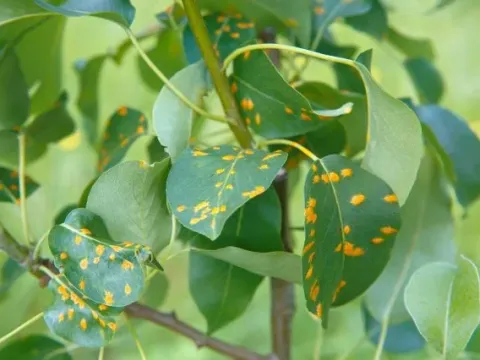
The primary symptom is the appearance of small, raised pustules on foliage and stems that look like brownish or orange rust, giving the disease its common name.
These pustules eventually rupture the leaf surface, releasing mass amounts of powdery spores that can easily be dispersed by wind or splashing water.
As the plant progresses toward maturity, the pustules may change color to a darker brown or black, representing the transition to the overwintering stage of the fungus.
Affected plants often show chlorosis (yellowing) and necrosis, leading to premature leaf drop and overall thinning of the canopy.
In severe cases, the stems become deformed or brittle, which significantly weakens the structural integrity of the plant.
The development of rust fungi is strongly favored by high humidity, prolonged dew, fog, and moderate temperatures ranging from 15°C to 25°C.
Dense planting patterns that restrict airflow create a stagnant microclimate, which is ideal for spore germination and rapid colonization of the crop.
Excessive application of nitrogen fertilizers produces lush, succulent growth that is more prone to penetration by fungal germ tubes.
The proximity of alternate hosts, such as barberry or buckthorn, creates a source of primary inoculum that can infect nearby fields early in the growing season.
Wind-driven rain and humid air currents are the primary drivers for the long-distance spread of the disease, often leading to large-scale epidemics.
Rust diseases cause significant economic loss by diverting essential plant resources away from fruit and seed production toward the fungus.
The disruption of the leaf epidermis leads to uncontrolled transpiration, which puts the plant under severe water stress and reduces its tolerance to drought.
Crop quality is drastically reduced; for instance, cereal grains may become shriveled, light in weight, and possess poor processing qualities.
Widespread infections can destroy the entire photosynthetic capacity of the plant, often leading to total crop failure in highly susceptible varieties.
Weakened plants are not only unproductive but also exhibit decreased resilience, making them highly susceptible to secondary pests and pathogens.
The most effective strategy for managing rust is the use of disease-resistant or tolerant crop varieties specifically developed for regional fungal races.
Implementing a proper crop rotation scheme breaks the lifecycle of the pathogen and prevents the buildup of spores in the soil and debris.
Applying protective or systemic fungicides at the early onset of infection is critical to stopping the spread and protecting the yield.
- Maintaining appropriate field spacing for ventilation
- Balanced fertilization to avoid succulent growth
- Removal of infected crop residues and weeds
- Regular field scouting to detect early pustules