
Rusty-brown cort
Cortinarius subferrugineus
Description
Symptoms
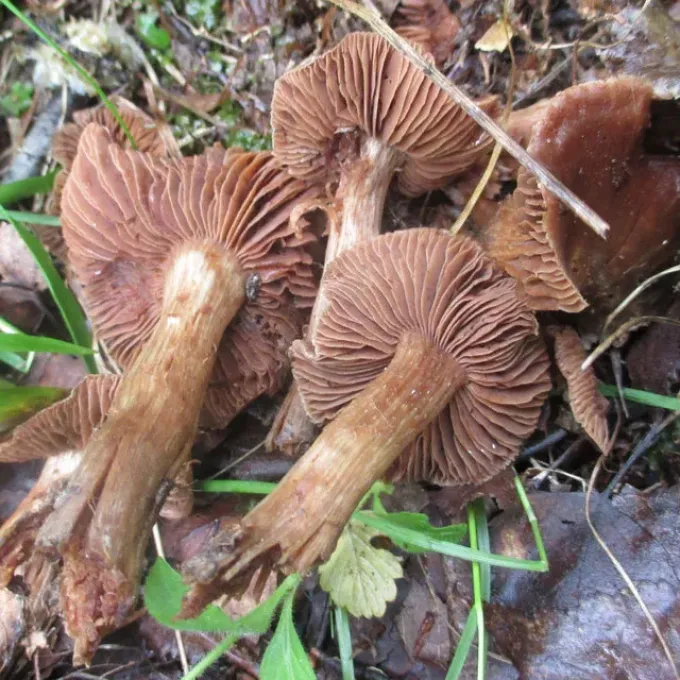
The primary sign of its presence is the emergence of dense fruiting bodies in the soil around tree trunks. The caps typically measure between 5 and 12 centimeters and exhibit a distinct, vibrant rusty-brown coloration.
The gills of the fungus show a transition in color: starting as a pale yellowish shade in young stages and darkening to a rusty-brown as the spores mature and are dispersed.
A fibrous, sometimes ochre-tinged stem is another characteristic feature. The stem remains sturdy and holds the cap, often bearing traces of the cortina in the early stages of development.
Mycelial mats are often found in the organic layer of the forest soil. These mats can be observed when clearing the leaf litter, revealing a network of fine white or yellowish threads interacting with tree roots.
There are no visible "disease" symptoms on the tree canopy associated with this fungus, as the interaction is generally symbiotic rather than parasitic in nature.
Pathogen
Cortinarius subferrugineus, commonly known as the rusty-brown cort, is a species of fungus in the Cortinariaceae family. It is widely distributed across temperate forest regions and serves as a significant mycorrhizal partner for various tree species.
The fungus is characterized by its rusty-brown cap and the remnants of a cobweb-like veil (cortina) that is clearly visible in young specimens. This structure helps protect the developing gills before the spores are released into the environment.
Biological activity is concentrated in the soil, where the fungal mycelium forms a symbiotic interface with the roots of conifers and broadleaf trees. This relationship allows the fungus to exchange minerals for sugars produced by the tree.
Reproduction occurs through the release of basidiospores, which germinate under favorable environmental conditions to initiate a new colony of mycelium in the forest floor.
As a mycorrhizal fungus, it plays a critical role in nutrient cycling, ensuring that the host trees receive essential water and micronutrients necessary for their growth in competitive forest environments.
Conditions for development
Cortinarius subferrugineus thrives in environments characterized by high soil humidity and acidic to neutral soil pH levels. It is most active during the late summer and autumn seasons.
Optimal growth temperatures for the development of fruiting bodies generally fall within the range of 12 to 20 degrees Celsius. Excessive heat or prolonged drought can inhibit the development of the fungal colonies.
The presence of a suitable host tree is the most important ecological condition. Without the mycorrhizal connection to the root system, the fungal mycelium cannot achieve full development or fruit.
Forest management practices that maintain the integrity of the soil structure and protect the leaf litter layer are essential for the long-term survival of this species.
Excessive soil compaction, typically caused by heavy machinery in forest areas, can disrupt the mycelial network and reduce the occurrence of the fungus in affected zones.
Why it matters
The species does not cause economic harm to crops, as its niche is exclusively within forested or wooded areas. It is not considered a pathogen that leads to rot or decline in healthy trees.
In nursery settings, however, the dense colonization of roots by mycorrhizal fungi can sometimes compete with seedling nutrient intake, though this is rare and usually only occurs under specific imbalance conditions.
Ecologically, the fungus is beneficial rather than harmful. It enhances tree resistance to environmental stress, including drought and nutrient deficiency, by expanding the reach of the root system.
The rusty-brown cort is not known to produce toxins that pose a threat to plant health or neighboring flora, making it an ecologically safe inhabitant of woodland ecosystems.
No agricultural intervention is required, as the biological impact of this fungus is neutral or positive in terms of forest health and natural succession.
Protection
No control measures are necessary for Cortinarius subferrugineus because it is a natural component of healthy forest soils and does not pose a threat to plants.
If management of the fungal population is required in a forest nursery environment, focusing on soil drainage and the optimization of soil aeration is the most effective approach.
Standard horticultural practices, such as preventing waterlogging and ensuring the use of clean, pathogen-free growing media, effectively regulate the density of any soil-borne fungal growth.
Biological controls, such as the application of beneficial rhizobacteria, can maintain the microbial balance of the soil and prevent excessive colonization by specific fungal species.
- Maintain proper drainage in forest nurseries.
- Avoid excessive irrigation during the growing season.
- Use sterilized substrates for seedling container cultivation.
- Monitor soil pH to ensure it remains within the optimal range for the desired plants.
Discussion
No discussions yet — be the first.