
Rust disease
Pucciniomycetes
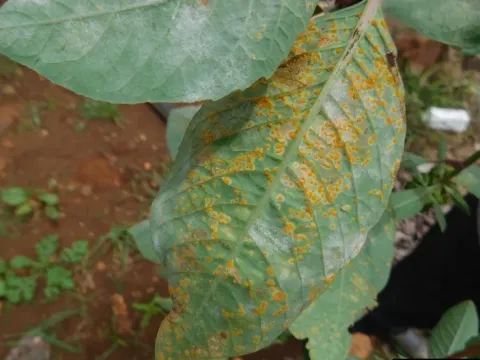
The hallmark symptom of rust disease is the emergence of pustules on leaves, stems, and seed heads. These pustules represent dense clusters of fungal spores breaking through the plant cuticle.
What the section contains
Rust disease
Depending on the specific rust species, pustules exhibit a range of colors, typically appearing as yellow, orange, reddish-brown, or dark black powdery spots.
Surrounding the pustules, the plant tissue often becomes chlorotic, showing yellowing or necrotic areas where the fungus is actively extracting nutrients from the host cells.
As the infection progresses, the epidermis ruptures, releasing massive quantities of spores that are easily wind-dispersed to neighboring healthy plants.
Severe infestations lead to premature leaf drop, stunted growth, and the overall wilting of the plant as its water and nutrient transport systems are compromised.
Rust diseases are caused by fungi belonging to the class Pucciniomycetes. These are highly specialized obligate biotrophs that rely entirely on living plant tissue to complete their life cycle.
Many rust fungi have complex life cycles that may involve up to five distinct spore stages and occasionally the requirement of an alternate host species to survive.
Fungal hyphae penetrate the plant through natural openings like stomata or by directly piercing the plant surface using specialized appressoria.
Once inside, the mycelium grows intercellularly, forming haustoria—specialized structures that penetrate the cell walls to absorb essential nutrients directly from the host.
The ability of these pathogens to rapidly mutate and develop new races presents a constant challenge for breeding rust-resistant crop varieties.
The development of rust disease is heavily dependent on moisture. High relative humidity, heavy dews, and frequent rainfall are essential for spore germination and infection.
Temperature plays a critical role in the rate of disease spread, with most Pucciniomycetes species thriving in moderate climates between 15°C and 25°C.
Dense crop canopies that limit airflow and trap humidity create an ideal microenvironment for rapid fungal colonization and the development of severe epiphytotics.
Excessive nitrogen application can encourage succulent plant growth, making the tissues more susceptible to penetration by fungal hyphae.
Survival of the pathogen over the winter is primarily mediated by dormant spores on plant debris or infected self-sown plants, which act as initial inoculum sources.
Rust fungi are major agricultural pests, capable of causing significant yield losses by reducing the plant's photosynthetic capacity and diverting nutrients to spore production.
By damaging the leaves and stem tissues, the infection reduces grain filling, resulting in shriveled kernels, lower test weight, and reduced nutritional quality of the harvest.
The weakened structural integrity of the stems caused by rust often leads to lodging, making mechanical harvesting difficult and further increasing losses.
In high-pressure years, if left unmanaged, rust outbreaks can decimate entire fields, leading to total economic losses for the farming operation.
The cumulative stress from rust infection can also weaken the plant's natural defenses, predisposing it to secondary infections and physiological damage.
The most sustainable strategy for managing rust is the use of genetically resistant cultivars, which provide the first line of defense against specific races of the fungus.
Integrated pest management practices, including crop rotation and the destruction of alternate hosts or volunteer plants, help disrupt the pathogen's life cycle.
Timely application of systemic fungicides, particularly those belonging to the triazole or strobilurin classes, is essential when infection thresholds are reached.
Regular field scouting is vital for early detection, as interventions are significantly more effective when applied during the early stages of disease development.
- Maintaining proper plant spacing to improve canopy aeration.
- Balanced fertilization programs that prevent excessive nitrogen uptake.
- Use of high-quality, fungicide-treated seed to ensure healthy early growth.