
Rust disease
Pucciniales
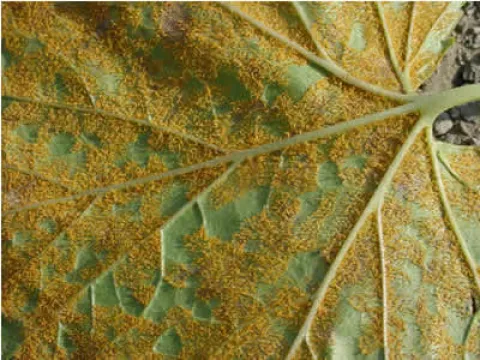
The primary symptom of rust disease is the emergence of small, pustule-like spots on leaves and stems, often containing powdery, rust-colored spores.
What the section contains
Rust disease
These spots range in color from yellow-orange to dark brown or even black, reflecting the different developmental stages of the fungal life cycle.
Infected tissue typically ruptures, releasing millions of spores that are easily dispersed by wind, facilitating the rapid spread of the pathogen across fields.
Severe infestations lead to premature yellowing and necrosis of foliage, which drastically reduces the plant's photosynthetic capacity and vitality.
When the disease reaches the grain-filling stage, the resulting seeds are often shriveled and low in quality, leading to significant yield losses.
Rust diseases are caused by specialized parasitic fungi belonging to the order Pucciniales, which are classified as obligate biotrophs.
These fungi have complex life cycles and often require two distinct host plants to complete their reproductive cycle, making them highly adaptive.
The pathogen infects plants by entering through the stomata and establishing a mycelial network within the intercellular spaces to extract nutrients.
Throughout the growing season, the fungus produces multiple generations of spores, allowing for explosive population growth when conditions are favorable.
Rust fungi commonly overwinter as teliospores on crop residues or as active mycelium on winter crops and wild grasses, providing a source for new infections.
Rust development is heavily favored by cool to moderate temperatures combined with high humidity and prolonged periods of leaf wetness.
Free moisture, such as heavy dew or frequent rainfall, is essential for the germination of spores and the subsequent successful infection of plant tissue.
Optimal environmental conditions for disease progression often occur during mild, wet springs or early summers when plants are at their most vulnerable stage.
High planting densities and poor field aeration contribute to a localized microclimate that promotes rapid spore dispersal and infection rates.
Plants subjected to nutrient imbalances, particularly excessive nitrogen, often exhibit softer tissues that are more susceptible to fungal penetration.
Rust diseases cause severe damage to a wide range of agricultural crops, including cereals, legumes, and various ornamental and fruit-bearing plants.
The core damage stems from the fungus redirecting photosynthates from the plant's productive organs to its own reproductive structures.
Stalk infection interferes with vascular transport, weakening the plant structure and increasing the risk of lodging, which complicates harvesting efforts.
In cases of widespread outbreaks, total crop failure is possible, with yield losses frequently exceeding 50 percent in susceptible varieties.
Beyond quantity, the quality of the harvested produce is often compromised, leading to lower market values and reduced viability for future seeds.
The most effective strategy for managing rust is the utilization of resistant or tolerant crop varieties that are adapted to local pathogen races.
Cultural practices, including crop rotation and the systematic elimination of weeds or volunteer plants, are critical for disrupting the fungal life cycle.
Timely field sanitation, including the deep burial of crop debris, helps to minimize the initial inoculum levels present in the soil and environment.
Chemical control using systemic fungicides is highly effective if applied early upon the first sign of infection to prevent the escalation of the disease.
Integrated pest management programs, involving constant field monitoring and precise chemical applications, are essential to maintain control over large acreages.