
Southern corn rust
Puccinia polysora
The causal agent of Southern corn rust is the obligate biotrophic fungus Puccinia polysora. It is a highly specialized pathogen that specifically targets maize (corn) and some related grass species.
What the section contains
Southern corn rust
The disease cycle is characterized by the production of urediniospores, which serve as the primary means of long-distance dispersal via wind currents. The fungus develops within the leaf tissue, erupting through the epidermis to release its spores.
Unlike other rust species that might persist on crop debris, Puccinia polysora generally requires living host tissue to complete its life cycle. It is primarily a pathogen of tropical and subtropical environments.
Under optimal conditions, the latent period from infection to the appearance of new pustules can be as short as one week. This rapid cycling allows the disease to reach epidemic proportions quickly in susceptible fields.
The biology of this fungus is strictly dependent on the host plant's physiology. It drains energy from the corn plant, diverting essential nutrients meant for grain fill to its own reproductive structures.
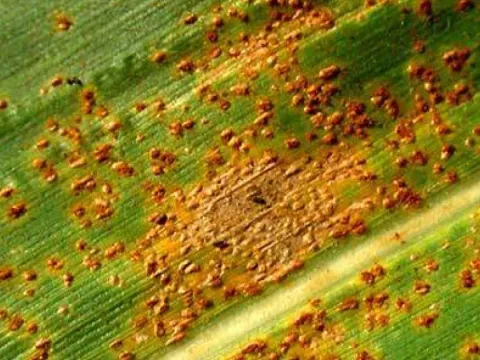
Southern corn rust is identified by the presence of small, circular to oval-shaped pustules on both surfaces of the leaves. These pustules are typically orange to reddish-brown in color.
As the infection progresses, the epidermis ruptures, releasing a fine, dusty mass of spores that can easily rub off on clothing or equipment. Pustules are often so dense that they appear to coat the leaf surface completely.
Severe infestations cause leaves to turn yellow, dry out, and eventually die prematurely. This leaf necrosis significantly reduces the plant's ability to conduct photosynthesis during critical grain-filling stages.
Southern corn rust is distinguishable from common rust by the smaller size of its pustules and their uniform distribution across the leaf. Common rust pustules are typically larger and darker.
In addition to leaf surfaces, pustules can occasionally form on the leaf sheaths if environmental conditions remain favorable for prolonged periods. Diagnostic confirmation usually requires microscopic examination of the spores.
The development of Puccinia polysora is highly favored by warm temperatures, typically ranging from 23°C to 30°C. These conditions accelerate the fungal metabolism and speed up the infection process.
High humidity and consistent leaf wetness are essential for spore germination and infection. Frequent rainfall, heavy dews, and overcast skies provide the ideal moisture levels for the disease to flourish.
Fields with dense plant populations often develop microclimates with poor air circulation, which helps keep the foliage wet for longer periods. This significantly increases the risk of a widespread outbreak.
Wind is the primary vector for spreading urediniospores across vast agricultural landscapes. Once the disease is introduced into a region, the primary limiting factor for its spread is the availability of host tissue and moisture.
Agricultural practices, such as irrigation in dry climates, can create artificial conditions that favor the pathogen. Proper field management is necessary to mitigate these risks throughout the growing season.
The economic impact of Southern corn rust is significant, primarily due to yield losses caused by the reduction in functional leaf area. This limits the energy available for kernel development and ear filling.
Yield reductions can be dramatic, often ranging between 30% and 50% in untreated, susceptible fields. The severity of the loss is directly proportional to how early the infection begins in the season.
Affected crops often exhibit poor kernel weight and lower overall test weight. The grain may become shriveled, which impacts the final market value and quality of the harvest.
In addition to direct yield loss, plants weakened by rust are more susceptible to stalk rot diseases. This can lead to plant lodging, making mechanical harvesting difficult and causing additional field losses.
The overall plant health is compromised, and the premature senescence of foliage may force an early harvest that is not physiologically optimal, further decreasing the potential yield output.
The most effective strategy for managing Southern corn rust is the deployment of resistant or tolerant corn hybrids. Breeding programs are continuously working to integrate effective resistance genes into commercial lines.
Fungicide applications are highly effective when timed correctly. Products containing triazoles and strobilurins are widely used to protect the crop once the first symptoms are detected in the field.
Integrated pest management (IPM) practices, such as crop rotation and the elimination of volunteer corn, are important for reducing local inoculum levels. However, because spores are wind-borne, long-distance migration often overrides local sanitation.
Scouting is crucial; agronomists recommend regular field checks, especially during the pre-tassel and silking stages. Early intervention is the key to preventing the loss of yield potential during the grain-filling phase.
- Utilize resistant corn hybrids as the primary defense mechanism.
- Apply foliar fungicides upon detection of initial pustules.
- Ensure proper nutrient management, focusing on balanced N-P-K levels.
- Monitor field conditions regularly during hot and humid periods.
- Implement early harvesting strategies if infection is severe to minimize stalk rot risks.