
Soybean anthracnose
Colletotrichum japonicum
Description
Symptoms
The initial symptoms are often seen on seedlings, where the hypocotyl and cotyledons develop dark, sunken lesions. This can lead to damping-off, where the young plants collapse and die before or shortly after emergence.
On adult plants, irregular necrotic spots appear on leaves, often bounded by darker margins. As the disease progresses, these lesions can coalesce, causing the leaves to turn yellow and drop prematurely.
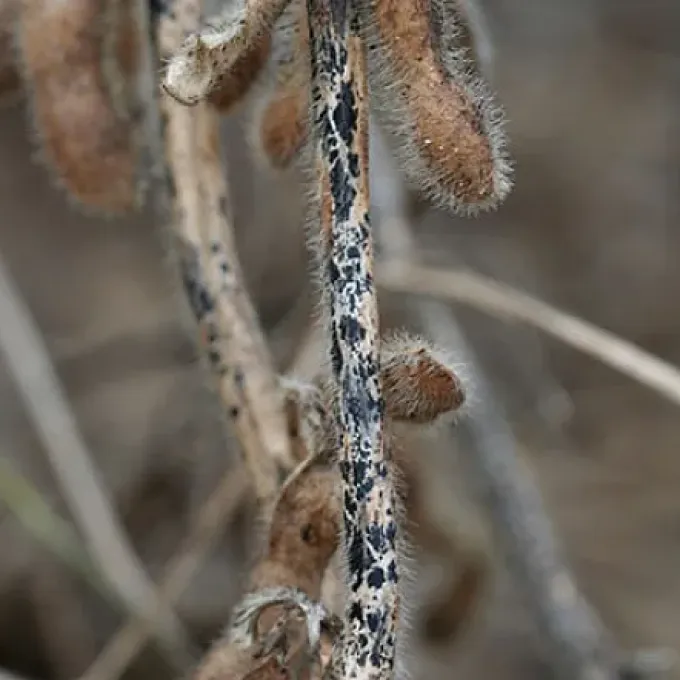
Stems and petioles exhibit elongated, brown cankers or lesions. If observed closely under high humidity, small black dots (acervuli) become visible, often surrounded by characteristic black hair-like structures called setae.
Pods infected by the fungus show dark, water-soaked spots. Inside these pods, seeds are often shriveled, moldy, or even completely absent if the infection occurred early in the pod-filling stage.
Under humid conditions, a whitish or pinkish mass of spores may be seen on the surface of the lesions. This sign is a clear indicator that the plant is serving as a source of secondary infection for the rest of the field.
Pathogen
The causative agent of this disease is the fungus Colletotrichum japonicum (also known as Colletotrichum truncatum). This pathogen belongs to the deuteromycete group and is a significant threat to soybean production globally.
The fungus produces spores in acervuli, which are cushion-like structures that break through the plant epidermis. These spores are disseminated primarily by splashing water from rain or irrigation, as well as by wind currents.
This pathogen survives the winter in infected crop residues left on the soil surface and can also persist in the soil for several years through the formation of sclerotia or latent mycelium.
Soybean anthracnose infects the host plant at all growth stages. The pathogen is a necrotroph, meaning it kills plant tissues and feeds on the dead organic matter, leading to rapid disease development under favorable conditions.
Its biological cycle is heavily dependent on moisture. Even a short period of leaf wetness allows the spores to germinate and penetrate the host tissue, making the management of this fungus highly dependent on environmental monitoring.
Conditions for development
The development of soybean anthracnose is favored by temperatures ranging from +20°C to +28°C. These temperatures are optimal for the rapid germination and colonization of host tissues by the fungus.
High humidity and frequent rainfall are the most critical factors for disease epidemics. Leaf wetness duration is directly correlated with the severity of the infection in a given field.
Dense crop canopies reduce airflow, maintaining high relative humidity around the lower parts of the plant. This microclimate is perfect for the survival and multiplication of the fungal spores.
Continuous cropping of soybeans without rotation allows the pathogen population to build up in the soil and on crop debris, significantly increasing the infection pressure each season.
Wounds caused by hail, insect feeding, or mechanical damage during cultivation provide easy entry points for the fungus, bypassing the plant's natural external defense barriers.
Why it matters
Soybean anthracnose is a destructive disease that can result in yield losses ranging from 20% to 50% under severe infestation. The damage is cumulative, affecting both the quantity and quality of the seeds.
The infection significantly reduces seed weight and oil content, leading to lower market value. Furthermore, infected seeds have poor germination rates, which affects the stand density of the subsequent crop.
Premature defoliation caused by the disease cuts off the plant's nutrient supply to the seeds. This leads to underdeveloped or aborted seeds, directly reducing the total grain yield per hectare.
Infected pods are prone to shattering before harvest, resulting in significant grain loss in the field. The weakened stalks are also more susceptible to lodging, which complicates the harvesting process.
The disease compromises the overall health of the crop, making it more susceptible to opportunistic pathogens, thereby reducing the plant's resistance to environmental stresses.
Protection
The primary control measure is the use of high-quality, certified seeds treated with effective systemic fungicides to eliminate any seed-borne pathogens before planting.
Implementing a proper crop rotation system is essential. Rotating soybeans with non-host crops like cereals or corn for at least 3 years helps to naturally reduce the pathogen load in the field.
Deep plowing of crop residues after harvest is recommended to bury infected tissues, accelerating their decomposition and preventing the fungus from surviving on the surface.
Timely application of foliar fungicides during the flowering and pod-filling stages is highly effective if weather conditions favor the disease development.
- Choosing tolerant or resistant soybean varieties suited to the local climate.
- Managing weed populations that might act as alternative hosts for the pathogen.
- Adjusting planting density to improve air circulation and reduce leaf wetness duration.
Discussion
No discussions yet — be the first.