
Soybean anthracnose
Colletotrichum truncatum
Description
Symptoms
Symptoms appear early on as dark, necrotic lesions on cotyledons and stems of seedlings, often leading to damping-off and poor stand establishment in the field.
On leaves, the disease manifests as brown, irregular lesions that can coalesce, causing the leaf tissue to wither and eventually leading to premature defoliation.
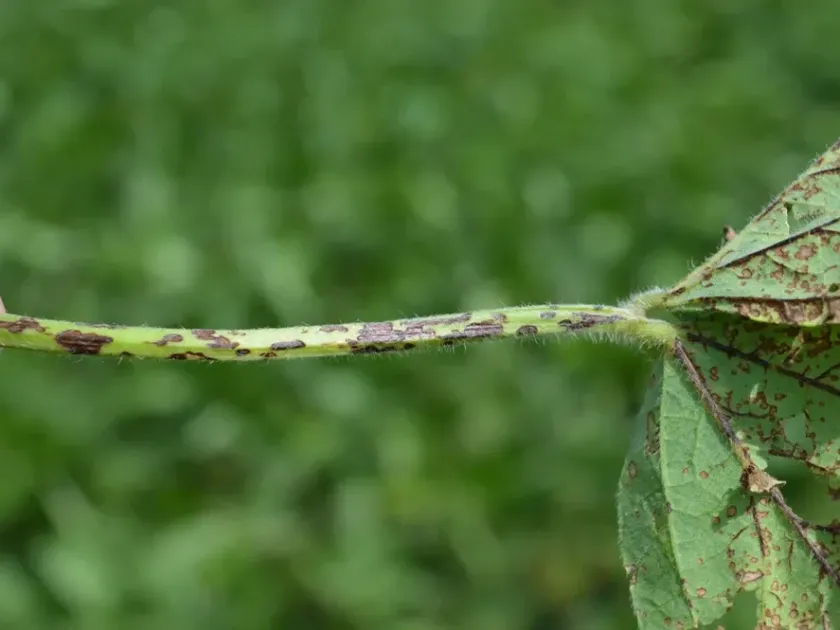
Stems and petioles show elongated, dark-colored lesions. Under high humidity, these areas develop black acervuli, sometimes accompanied by dark, stiff setae that can be seen with magnification.
Pod infection is particularly damaging, characterized by dark brown spots and mycelial growth on the pod surface, which hinders seed development and quality.
In mature plants, the disease can cause a general decline in plant vigor, with stems appearing gray or dark brown as the fungal infection progresses throughout the canopy.
Pathogen
The causal agent of soybean anthracnose is the fungus Colletotrichum truncatum. It is a highly destructive pathogen that can infect the crop at all growth stages, from seedling emergence to physiological maturity.
The pathogen overwinters in infected crop residue, soil, and seeds. Seed transmission is a critical pathway, allowing the fungus to spread across new regions even in previously healthy fields.
The fungus produces asexual spores called conidia, which are borne in specialized fruiting bodies known as acervuli. These structures are often visible as black dots on infected plant tissues.
Colletotrichum truncatum has a broad host range, infecting various legumes including dry beans and chickpeas, which complicates crop rotation strategies for integrated pest management.
It acts as a hemibiotroph, initially invading live tissue and later colonizing senescing or dead plant parts, effectively completing its reproductive cycle in the field.
Conditions for development
The development of soybean anthracnose is favored by warm, humid conditions. Temperatures between 22°C and 28°C combined with frequent rainfall are optimal for disease spread.
Splashing rain and wind are the primary mechanisms for dispersing conidia from soil-borne residues or lower infected leaves to the upper canopy of the plant.
High relative humidity levels (above 85%) within the crop canopy are essential for the germination of conidia and successful infection of the host tissue.
Mechanical damage caused by hail, heavy wind, or insect feeding creates entry points for the pathogen, significantly increasing the severity of the infection.
Densely planted fields or weed-infested crops create poor air circulation, which keeps the foliage wet for longer periods, facilitating fungal development.
Why it matters
Soybean anthracnose is a significant threat to yield, causing losses that can range from 15% to over 40% depending on the timing of the infection and weather severity.
The disease reduces the number of seeds per pod and negatively impacts the weight of individual seeds, directly reducing overall market yield.
Seed quality is severely compromised; infected seeds are often shriveled, discolored, and carry the pathogen, which reduces their value for both processing and future planting.
Reduced photosynthetic leaf area due to premature defoliation prevents the plant from effectively filling pods, leading to poor grain development.
The presence of anthracnose creates additional stress on the plant, making it more susceptible to other secondary pathogens and environmental factors during the grain-filling stage.
Protection
The primary control strategy involves the use of high-quality, certified seeds treated with effective systemic fungicides to prevent early-season seedling blight.
Implementing a crop rotation program (3-4 years) with non-host crops is essential for reducing the inoculum density of the fungus in the soil over time.
Aggressive management of crop residues, such as deep tillage where appropriate, helps accelerate the breakdown of infected debris and reduces overwintering sites.
Foliar application of fungicides during the R1 to R5 growth stages can provide substantial protection, particularly in high-risk areas with consistent rainfall.
- Select soybean varieties with proven resistance or tolerance to anthracnose.
- Control weeds that might serve as alternative hosts for the pathogen.
- Maintain optimal plant density to ensure adequate air circulation and faster canopy drying.
Discussion
No discussions yet — be the first.