
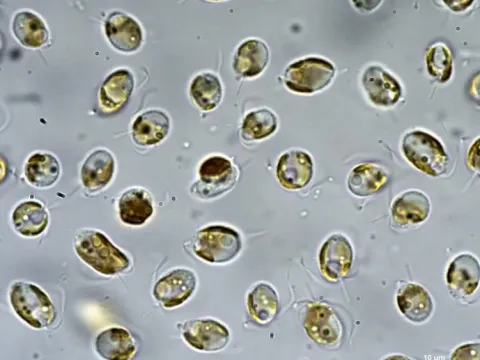
Prymnesium parvum
Prymnesium parvum
Prymnesium parvum is a microscopic, single-celled flagellated alga belonging to the haptophyte division.
What the section contains
Prymnesium parvum
This organism is known for its complex biology, often shifting between different life stages depending on environmental factors.
It is classified as a mixotroph, meaning it can survive through photosynthesis while also consuming organic particles from the water column.
The primary concern regarding this alga is its ability to synthesize potent exotoxins known as prymnesins.
While globally distributed, it thrives in brackish and inland freshwater ecosystems, demonstrating significant salinity tolerance.
The proliferation of Prymnesium parvum is largely driven by water temperatures ranging from 10°C to 25°C.
Nutrient enrichment, particularly high concentrations of nitrogen and phosphorus, provides the essential fuel for rapid algal blooms.
Stagnant or low-flow water bodies are particularly susceptible to massive growth due to limited flushing and accumulation of nutrients.
Sunlight penetration is crucial, as the organism requires sufficient irradiance to sustain its high rate of cellular division.
Fluctuations in water chemistry, including pH levels and the presence of certain trace minerals, can trigger or terminate bloom events.
The alga produces toxins that specifically target the gill tissues of fish, crustaceans, and other gill-breathing aquatic organisms.
These toxins impair the respiratory and osmoregulatory systems, leading to rapid mortality regardless of the dissolved oxygen levels.
Major bloom events often result in total collapse of the fish population in affected lakes, ponds, and aquaculture facilities.
The loss of biodiversity extends to zooplankton, effectively stripping the aquatic ecosystem of its natural food web integrity.
The economic impact on commercial fisheries and the environmental damage to local ecosystems can be extensive and difficult to remediate.
Effective management begins with routine water quality testing to detect the presence and density of Prymnesium parvum cells.
Application of selective algaecides can successfully reduce cell populations if the bloom is identified at an early stage.
Long-term control involves reducing nutrient runoff from surrounding agricultural lands to minimize the risk of eutrophication.
Water circulation techniques, such as the use of aerators or fountains, help disrupt the calm conditions favored by the alga.
Adding clay minerals to the water column is a common bio-remediation technique that helps aggregate algal cells, leading to their settling and removal.