
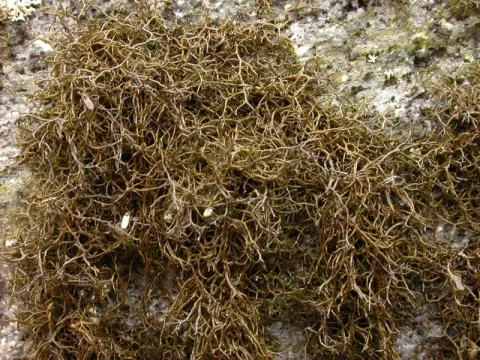
Pseudephebe pubescens
Pseudephebe pubescens
Pseudephebe pubescens is a fruticose lichen characterized by dense, dark brown to blackish tufts growing on rock surfaces.
What the section contains
Pseudephebe pubescens
The thallus is highly branched and consists of rigid, hair-like segments that provide a distinct tufted appearance to the colony.
This species primarily thrives in cold, harsh environments such as arctic tundras and high-altitude alpine zones.
It adheres firmly to its rocky substrate, allowing it to withstand extreme wind speeds and fluctuating arctic temperatures.
Visually, colonies appear as dark patches that can cover significant areas of stone or exposed mountainous terrain.
It is crucial to clarify that Pseudephebe pubescens is not a plant disease and does not act as a pathogen to crops or trees.
It is a symbiotic organism comprised of a fungal component (mycobiont) and a photosynthetic partner (photobiont).
This lichen relies entirely on photosynthesis and atmospheric moisture for growth, rather than extracting nutrients from host plants.
Taxonomically, it belongs to the class Lecanoromycetes and is considered an epilithic or epiphytic organism depending on the substrate.
The misclassification of this species as a disease agent is a common misconception that does not reflect its true biological nature.
Development of this species is strictly limited to regions with very low average temperatures and high environmental purity.
The lichen is extremely sensitive to atmospheric pollution, acting as a natural bioindicator of air quality in pristine regions.
High levels of humidity are essential for its survival, which it obtains from fog, snowmelt, and frequent precipitation.
It prefers exposed locations where it receives sufficient light for photosynthesis while being shielded from competitive vascular vegetation.
The metabolic activity of the lichen occurs during the short growing seasons characteristic of polar and high-altitude mountainous latitudes.
Pseudephebe pubescens poses no threat to agricultural crops, orchards, or forest plantation health.
As an organism that lives on rocks or bark surfaces without parasitic interaction, it does not impede the growth of living plants.
It does not produce toxins or enzymes that could degrade plant tissues, distinguishing it from true fungal or bacterial pathogens.
Instead of causing harm, it plays a role in the natural weathering of rocks, which eventually contributes to soil formation processes.
Agricultural monitoring programs do not consider this species a risk factor, as it has no economic impact on crop productivity.
No chemical or biological control measures are required, as the organism is entirely harmless to the agricultural sector.
Mechanical removal via scrubbing or pressure washing is the only method to clear it from ornamental stonework if desired for aesthetic reasons.
The application of fungicides against this lichen is strictly discouraged, as it disrupts the local ecology without providing any crop protection benefits.
No preventive measures are necessary, given the species is a natural component of its native arctic and alpine habitats.
Educating growers on the difference between lichen colonization and actual plant disease is the most effective approach for proper ecosystem management.