
Pseudevernia furfuracea
Pseudevernia furfuracea
Description
Symptoms
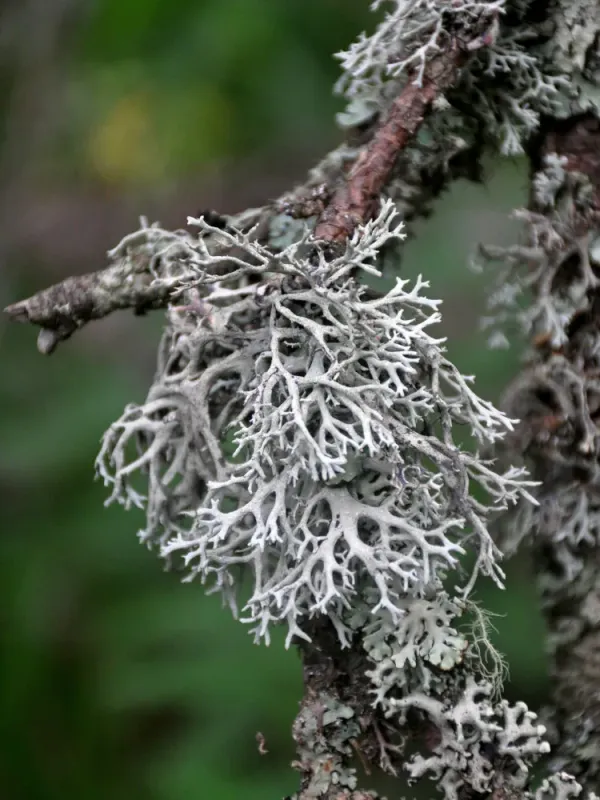
The primary sign of Pseudevernia furfuracea is the appearance of gray or grayish-brown, bushy growths on the trunks and major limbs of trees. These are most visible during moist or cool weather.
Upon closer inspection, the lichen is seen attached to the bark by rhizines, allowing it to be easily scraped off. The bark beneath typically remains intact, though it may appear slightly more humid due to water retention.
It is predominantly found on older trees with rough, fissured bark, as these surfaces provide better anchorage for the lichen than the smooth, fast-growing bark of young saplings.
Massive colonization usually occurs on the shaded or wetter sides of the tree, where sunlight is limited and moisture levels remain high for longer periods after rainfall.
Heavy colonization may make the tree look neglected or aged, which is a common observation in unmaintained or long-standing orchards.
Pathogen
Pseudevernia furfuracea, commonly known as tree moss or shredded lichen, is a fruticose lichen belonging to the Parmeliaceae family. It is vital to recognize that it is not a plant disease in the pathological sense, but rather an epiphyte using the tree bark strictly as a structural support.
This organism is a symbiotic association between a fungus and algae or cyanobacteria. The fungal partner provides the structure, while the photosynthetic partner provides nutrients, meaning it does not feed on the tree’s sap or tissues.
Often misidentified as a parasite, Pseudevernia does not penetrate the tree's vital layers. Its presence is usually a sign of environmental stability and clean air, as it is highly sensitive to sulfur dioxide pollution.
Propagation occurs primarily through vegetative fragmentation. Small pieces of the lichen's thallus are easily dispersed by wind and rain, allowing it to colonize new sections of the bark.
Visually, it appears as grayish, strap-like, and branched structures, often with small, spine-like projections called isidia, which give it a rough or "furry" texture.
Conditions for development
High relative humidity is the fundamental requirement for the growth of Pseudevernia furfuracea. Consequently, it thrives in gardens with poor airflow and frequent fog or high rainfall.
Overcrowded tree canopies that prevent sunlight from reaching the trunk create an ideal microclimate for the lichen to spread and establish itself on the lower branches.
Tree age and bark condition are significant factors; trees with slow bark growth and deep crevices provide a stable substrate that allows the lichen to grow undisturbed for many seasons.
Poor orchard management practices, such as neglecting pruning and sanitary maintenance, are key factors that allow the lichen to accumulate over time.
Regional climate, especially temperate environments with extended cool, damp autumn and spring seasons, significantly favors the rapid colonization of tree surfaces by this epiphyte.
Why it matters
Although not a parasite, heavy lichen cover can indirectly cause issues. A thick layer of lichen can slightly impede the tree's bark respiration by covering lenticels, which are essential for gas exchange.
Dense lichen patches serve as a refuge for various pests, including scale insects, mites, and their eggs, providing them with shelter from predators and environmental extremes.
Prolonged moisture retention on the bark surface, held by the lichen, can create an environment conducive to the development of secondary bacterial or fungal infections.
Excessive growth can be an indicator of a tree's declining vigor or a sign that the environment is stagnant, which can impact the overall health and productivity of the orchard.
In extreme cases, the accumulation of epiphytic biomass can hinder the development of dormant buds and affect the tree’s natural bark shedding process.
Protection
The most effective physical control is mechanical removal. Using a stiff brush or a blunt scraper during wet weather helps remove the lichen without damaging the underlying bark.
After physical removal, applying a solution of iron sulfate (3–5%) serves as an excellent disinfectant, inhibiting the regrowth of lichens and eliminating latent fungal spores.
Proper pruning is essential to improve sunlight penetration and air circulation within the canopy, which effectively discourages lichen establishment and makes the bark drier.
Whitewashing tree trunks with a mix of lime and copper sulfate is a traditional and effective barrier method that prevents lichens from attaching to the surface.
Implementing a comprehensive orchard care strategy, including proper fertilization and irrigation, keeps trees vigorous and stimulates healthy bark growth, which helps in natural self-cleaning.
Discussion
No discussions yet — be the first.