
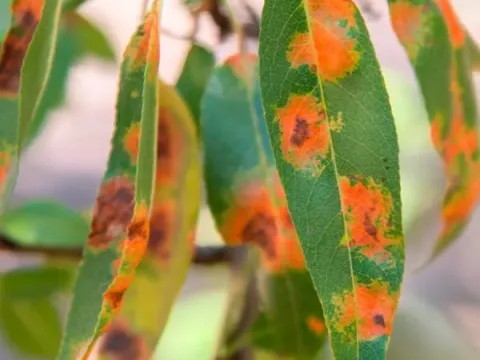
Red leaf blotch of almond
Polystigma amygdalinum
The causative agent of this disease is the ascomycete fungus Polystigma amygdalinum. It is an obligate parasite that relies entirely on the tissues of the almond tree to complete its complex biological cycle.
What the section contains
Red leaf blotch of almond
The fungus overwinters in infected fallen leaves, where it develops its sexual fruiting bodies, known as perithecia. As spring arrives, moisture triggers the release of ascospores into the air.
These spores land on the young, susceptible leaves of almond trees, where they germinate and penetrate the epidermal layer. Once inside, the fungal mycelium grows within the leaf tissue, gradually consuming nutrients.
Throughout the season, the pathogen continues to develop within the host, eventually producing new fruiting bodies that will ensure the survival of the fungus through the following winter.
Because the fungus is so specialized, it has developed sophisticated mechanisms to synchronize its development with the phenological stages of the almond tree, maximizing its success rate in spreading.
The disease first manifests as small, pale yellow or light green spots on the upper leaf surface. As the infection progresses, these areas change to a distinctive bright red or orange-red color.
The affected areas often become thickened and slightly raised compared to the surrounding healthy tissue. This deformation disrupts the natural structure of the leaf, hindering normal physiological processes.
By mid-summer, tiny black dots appear on the red blotches, representing the fruiting bodies of the fungus. If the infection is severe, the spots coalesce and can cover a large portion of the leaf area.
Badly infected leaves typically yellow and drop prematurely. This extensive defoliation is a classic sign of a high disease pressure in an almond orchard.
- Bright red circular or irregular blotches on leaves.
- Thickening and deformation of the leaf tissue.
- Appearance of black pycnidia or ascomata on the spots.
- Premature leaf abscission and canopy thinning.
The primary driver for the development of red leaf blotch is high humidity paired with frequent spring rains. These conditions are essential for the germination of ascospores on the leaves.
Temperatures ranging from +15°C to +22°C are ideal for the rapid growth of the fungus. During these periods, the rate of infection in an almond orchard can increase exponentially if left untreated.
Poorly managed orchards with dense, overgrown canopies create trapped moisture. This lack of airflow prevents leaves from drying out quickly after rain, providing the perfect window for fungal penetration.
The presence of decomposing leaf litter from the previous season is the most significant source of primary inoculum. Keeping the orchard floor clean is crucial for mitigating disease spread.
Extended wet spells during the critical leaf-emergence phase often lead to severe outbreaks, making seasonal weather patterns a major factor in predicting the disease intensity for the year.
The most significant impact of the disease is the substantial reduction in the photosynthetic capacity of the tree. Less energy is produced, which directly limits the tree's growth and nut production.
Premature leaf drop forces the tree to enter winter in a weakened state. This depletion of starch and nutrient reserves makes the trees highly susceptible to winter cold damage and secondary infections.
Chronic infection over several years leads to a steady decline in tree vigor. Orchards affected by red leaf blotch consistently demonstrate reduced nut size and lower overall harvest quality.
In severe cases, the cumulative stress caused by repeated annual attacks can lead to the death of branches or even entire trees, particularly in susceptible cultivars and poorly maintained sites.
The economic harm is compounded by the rising costs of frequent fungicide applications and the long-term loss of productive capital when trees have to be removed and replaced prematurely.
Sanitation is the cornerstone of managing red leaf blotch. Removing and destroying all fallen leaves during the dormant season significantly reduces the amount of overwintering inoculum.
Deep plowing in the orchard during autumn or early spring can bury the infected debris, preventing the release of spores and breaking the life cycle of the pathogen.
Chemical control usually involves protective sprays with copper-based fungicides. Timing is critical: applications must be made before the fungal spores have the chance to penetrate the young leaves.
Pruning is essential to open the canopy, which improves air circulation and sunlight penetration. This helps the foliage dry out rapidly after rain, creating a hostile environment for the fungus.
Integrated management, which combines robust sanitation, proper nutrition to boost tree resilience, and targeted fungicide applications, is the most effective approach to keeping the orchard healthy.