
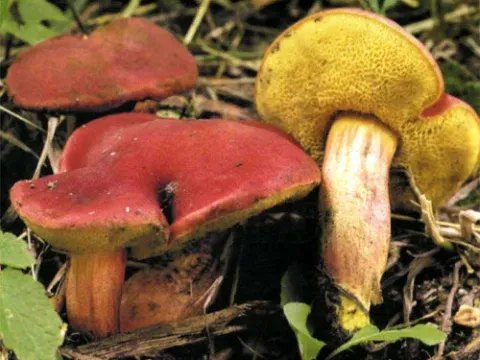
Red-cracked bolete
Xerocomus rubellus
The Red-cracked bolete (Xerocomus rubellus) is a small, tube-bearing fungus recognizable by its distinctive coloration. The cap, measuring 3 to 8 cm in diameter, is initially convex before becoming flat, with a velvety, reddish-brown to deep maroon texture.
What the section contains
Red-cracked bolete
The underside features yellow to olive-yellow tubes that turn distinctly blue when bruised or damaged. The stipe is typically slender, often curved, and displays shades of red or yellow with a granular surface pattern.
The flesh is yellowish and undergoes a rapid oxidation process, turning blue upon exposure to air. It possesses a faint, pleasant mushroom scent, though the texture is quite soft and can deteriorate quickly.
The spore print is olive-brown, which serves as a key diagnostic feature for mycological identification. These fungi typically grow in isolation or small clusters, preferring the shade and nutrient-rich leaf litter of deciduous woods.
A notable feature of this species is its rapid susceptibility to decay and insect infestation, which often makes the mushroom appear weathered or damaged even shortly after maturity.
The Red-cracked bolete is a mycorrhizal fungus that lives in symbiosis with deciduous trees, such as oak, beech, and hornbeam. It is not a plant pathogen and does not cause diseases in agricultural crops.
Biologically, it functions as a saprotroph and symbiont within forest ecosystems. It contributes to the decomposition of organic matter, assisting in soil nutrient cycling, which is beneficial rather than harmful.
It lacks the capability to infect living plant tissues; therefore, it does not induce blights, rots, or wilting in vegetables, grains, or horticultural plants. Misclassifying it as a disease is mycologically inaccurate.
Its life cycle is strictly tied to woodland environments where the root systems of host trees are present. It requires a specific mycological balance that is not found in typical intensive crop-growing fields.
In scientific terms, the organism acts as a decomposer and a partner in mycorrhizal relationships, playing no role in the pathology of crops or ornamental plants.
Red-cracked boletes require stable moisture levels in both the soil and the air to successfully develop their fruiting bodies. They are most commonly observed between July and October, following periods of consistent rainfall.
They favor moist, shaded environments, frequently appearing along forest edges, park paths, and shaded woodland areas. The presence of humus-rich, slightly acidic soil is a preferred condition for their growth.
Optimal temperatures for the emergence of fruiting bodies range from 15 to 22 degrees Celsius. Extreme cold or prolonged heat waves cause the mycelium to remain dormant.
Light levels are crucial; the fungus avoids direct sunlight, which can desiccate the tender fruiting body. It flourishes in areas where a dense canopy maintains high humidity levels close to the ground.
Spore dispersal is facilitated by wind and local insects. For spores to germinate, they require specific moisture content in the forest litter and the absence of inhibitory soil chemicals.
This species causes no harm to agricultural production or plant health. It does not possess any phytotoxic properties and does not affect the yield or quality of edible crops.
Any potential negative impact is purely limited to local aesthetics in landscaping if the mushroom growth is considered undesirable. However, it does not compete with plants for nutrients in a way that harms the crop.
The mushroom does not produce toxins that affect crops, nor does it carry plant viruses or bacteria. It remains a benign inhabitant of forest and garden soils under tree shade.
In modern agriculture, there is no need to monitor or control this species. Its presence is often an indicator of high soil organic content and an overall healthy forest ecosystem.
Economically, it has little impact on the agricultural sector, as its fast decomposition rate makes it impractical for large-scale commercial use.
No protection measures are required against the Red-cracked bolete, as it does not constitute a threat to plant pathology. The application of fungicides would be counterproductive and environmentally harmful.
If management is desired in a park or ornamental setting, cultural practices such as clearing excess leaf litter or woody debris can limit the availability of nutrients and moisture that the mycelium requires.
Improving soil drainage can also reduce the frequency of mushroom emergence, as it prevents the waterlogged conditions necessary for fruit body development.
Manual removal of fruiting bodies before they mature and release spores is the most effective way to prevent further expansion in a specific area, if control is deemed necessary.
It is recommended to maintain the natural microbial balance of the soil, as this supports the health of the trees that host these mycorrhizal fungi.