
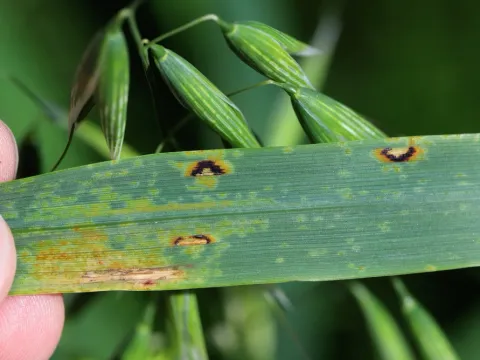
Red-brown leaf spot of oats
Pyrenophora avenae
The causal agent of red-brown leaf spot of oats is the fungus Pyrenophora avenae (anamorph Drechslera avenae). It belongs to the Ascomycota phylum and is a significant pathogen that affects oat crops globally.
What the section contains
Red-brown leaf spot of oats
The fungus is primarily seed-borne, with mycelium surviving within the oat grain. Additionally, the pathogen overwinters on infected plant debris and stubble, which serves as a major reservoir for the disease.
During the growing season, the fungus produces conidia, which are disseminated by wind and rain splashes. These spores land on healthy plants, initiating new infection cycles and rapidly spreading the disease through the crop.
The pathogen is highly adaptable and can infect oat plants at various stages of development, starting from the seedling stage through to heading, depending on environmental conditions.
Seeds harvested from heavily infested fields carry the fungus, which often leads to seedling blight if the planting material is not treated with appropriate fungicides before sowing.
Symptoms appear as small, red-brown spots on the leaves. As the disease progresses, these spots expand in size and can become elongated or oval, often surrounded by a chlorotic halo.
In the center of the spots, especially under humid conditions, an olive-black mold develops. This mold represents the conidial sporulation of the fungus, which is a diagnostic feature of the disease.
Severe infections lead to the premature yellowing and drying of leaves, starting from the lower leaves and progressing upwards. This significantly reduces the photosynthetic capacity of the plant.
In cases where the panicles are attacked, brown spots appear on the glumes and spikelets. This can lead to poor grain filling and the production of light, shriveled kernels.
- Red-brown lesions on leaf blades.
- Dark olive-black fungal growth in the lesion centers.
- Premature leaf senescence and wilting.
- Dark spots on panicles.
- Reduced plant vigor and stunted development.
The development of red-brown leaf spot is favored by cool, wet weather, particularly during the early stages of plant growth. Temperatures between +15°C and +20°C are optimal for spore germination.
High relative humidity, frequent fogs, and prolonged leaf wetness are critical factors that promote the rapid spread and establishment of the fungal infection within the field.
Cultural practices such as over-seeding or excessive plant density create a microclimate with reduced air circulation, which facilitates the buildup of moisture and accelerates disease progression.
Nutrient stress, particularly deficiencies in essential minerals like potassium and phosphorus, weakens the plants' natural defense mechanisms, making them more susceptible to fungal attack.
Early sowing in cold, damp soil can increase the risk of seedling infection, especially when using untreated or heavily infested seeds, as the fungus thrives in such conditions.
The primary damage caused by this disease is the reduction of the leaf surface area, which leads to a decrease in photosynthesis and overall grain yield, often resulting in significant economic losses.
Infected crops often produce lightweight, shriveled grains with reduced nutritional and commercial value. This can render the harvest unsuitable for milling or seed production.
Seedlings infected at an early stage may die or exhibit reduced vigor, leading to poor plant establishment and gaps in the field, which cannot be compensated for later in the season.
The disease weakens the overall physiological state of the crop, making it more vulnerable to secondary infections, pests, and environmental stressors like drought or lodging.
Reduced crop quality and yield mean that producers may face lower market prices and increased costs for additional inputs required to manage the disease across multiple seasons.
The first line of defense is the use of high-quality, disease-free seed. Seed treatments with systemic fungicides are essential to eliminate seed-borne pathogens and ensure healthy seedling establishment.
Crop rotation is a vital strategy for managing the disease. Avoiding consecutive cropping of oats on the same field for at least two to three years helps to deplete the soil inoculum levels.
Deep plowing of crop residues is a highly effective cultural practice. Burying the infected stubble speeds up the decomposition process and destroys the habitat where the fungus survives.
If the disease pressure is high, foliar fungicide applications during the tillering or stem elongation stages can be highly effective in preventing severe leaf damage and yield loss.
Balanced fertilization, based on soil analysis, promotes robust plant growth and increases natural resistance to the pathogen, while avoiding excessive nitrogen helps to prevent lush, susceptible canopy growth.