
Bean blight
Phytophthora phaseoli
The causative agent of the disease is the oomycete Phytophthora phaseoli, a highly specialized pathogen that primarily infects species within the Phaseolus genus.
What the section contains
Bean blight
This pathogen belongs to the class Oomycetes, commonly referred to as water molds, which require high humidity to complete their complex biological life cycle.
The pathogen reproduces via motile zoospores that navigate through water films on plant surfaces. Once a suitable host tissue is reached, the zoospores encyst and penetrate the plant cell walls.
The organism survives in the soil and on infected crop debris in the form of resilient oospores, which can remain viable in the environment for several years.
Phytophthora phaseoli is recognized globally as a serious pathogen that can lead to significant outbreaks in both home gardens and large-scale bean production fields.
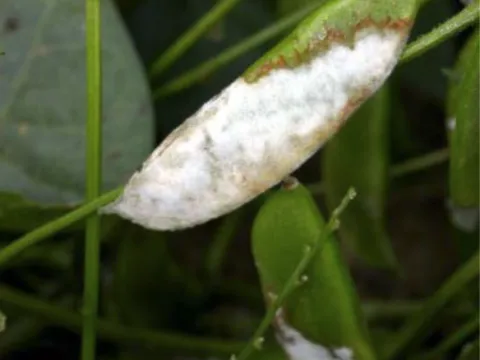
The most distinctive sign of bean blight is the presence of white, downy fungal-like growth appearing on the flower clusters (racemes) and young, developing bean pods.
Infected flowers usually become deformed, shrivel, and drop prematurely, resulting in poor pod set and drastic reductions in overall yield potential.
As the infection progresses, pods develop dark, water-soaked, or brownish sunken spots that may eventually spread to cover the entire surface, causing them to rot.
Leaf infection manifests as irregular, pale or chlorotic areas that eventually turn into necrotic lesions, often surrounded by a diffuse border during humid weather.
Under persistent wet conditions, the white mycelial mat becomes very visible, potentially spreading the pathogen to adjacent plants through windborne or rain-splashed spores.
High relative humidity and frequent rainfall are the primary environmental drivers for the development and spread of Phytophthora phaseoli.
Cool to moderate temperatures, typically ranging from 15°C to 22°C (59°F - 72°F), provide the optimal conditions for spore germination and active infection of host tissues.
Poor field ventilation caused by dense planting significantly increases the risk of the disease, as the foliage remains damp for longer periods throughout the day.
Overhead irrigation acts as an artificial rain, facilitating the splashing of zoospores onto healthy plant parts and creating a microclimate perfect for epidemic spread.
A history of contaminated soil, where the pathogen has been left behind from previous bean crops, is the most common starting point for an outbreak in any given season.
The damage caused by this pathogen can be severe, often leading to a total loss of the pod yield if the infection begins early during the flowering stage.
Beyond the direct impact on pod count, the quality of harvested seeds is severely compromised, as seeds from infected pods are often shriveled, discolored, and carry the fungus.
Increased susceptibility to secondary bacterial rots often follows the initial fungal attack, rendering the remaining crop unmarketable and difficult to store.
In a commercial context, the presence of this disease can lead to strict quarantine requirements and the total rejection of bean harvests by processing facilities.
The economic impact is exacerbated by the cost of intensive fungicide applications and the need for rigorous land management practices to mitigate future infestations.
Crop rotation remains the most critical management tool; avoiding beans in the same soil for at least three to four years helps drastically lower the initial inoculum levels.
Selecting resistant cultivars or varieties adapted to local conditions is a highly effective strategy to minimize disease severity without relying heavily on chemicals.
Field sanitation is essential; all infected plant debris must be removed and destroyed or deep-plowed immediately after harvest to prevent the survival of oospores.
Fungicidal applications, particularly those containing copper-based compounds or systemic agents, can protect the crop if applied early upon the detection of initial symptoms.
- Maintain adequate plant spacing to promote airflow.
- Use drip irrigation instead of overhead systems to keep foliage dry.
- Implement strict weed control to remove alternative hosts.
- Use certified, disease-free seed stock for every planting.