
Description
Symptoms
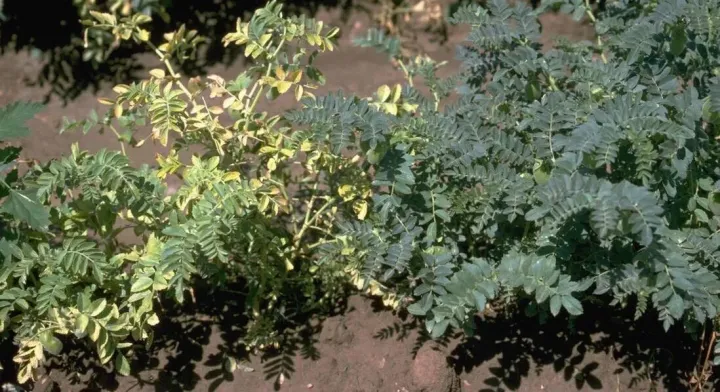
The most distinctive symptom is the upward rolling of leaf edges, which is often accompanied by yellowing (chlorosis) of the leaves. The foliage becomes thick, stiff, and brittle.
Infected plants exhibit severe stunting and reduced biomass compared to healthy individuals, leading to a patchy and uneven crop canopy.
Alfalfa crops affected by the virus show symptoms such as general yellowing and dwarfing, which may be mistaken for nutrient deficiency but persist despite fertilization.
Soybeans show signs of leaf deformation and a significant reduction in the number of pods. Premature flower and pod abortion is common in heavily infected plants.
Visual symptoms can vary depending on the plant cultivar's susceptibility and the specific viral strain, often making field diagnosis difficult without laboratory confirmation.
Pathogen
The Bean leafroll virus (BLRV) is a member of the Luteovirus genus. It is a phloem-limited virus that specifically attacks legume crops, causing systemic infection.
The virus is not transmitted mechanically through sap or via infected seeds. It relies entirely on insect vectors for its transmission from plant to plant.
Aphids are the primary vectors of BLRV, with the pea aphid (Acyrthosiphon pisum) being the most significant species responsible for spreading the disease in agricultural fields.
Transmission occurs in a persistent manner, meaning the aphid acquires the virus after feeding on an infected plant and retains the ability to transmit it for the rest of its life.
The virus affects a broad range of hosts, with high economic impact observed in crops like soybeans, alfalfa, beans, and chickpeas.
Conditions for development
The development of the disease is strictly dependent on the population dynamics of aphid vectors. Outbreaks usually coincide with periods of high aphid migration.
Warm and dry weather conditions favor the rapid buildup of aphid populations, which accelerates the spread of the virus throughout the field.
Perennial legumes, especially alfalfa, serve as critical reservoirs that harbor the virus during the winter and act as sources for new infections in spring.
Weed-infested field borders and uncultivated areas provide refuge for aphids, ensuring the virus persists even when the primary host crop is not in the field.
The severity of the outbreak is determined by the timing of the initial aphid infestation; early arrival of viruliferous aphids leads to significantly higher yield losses.
Why it matters
The virus causes substantial economic losses by reducing both seed yields and the nutritional quality of the produce, including lower protein content in seeds.
Infection compromises the plant's physiological integrity, making it more vulnerable to secondary infections by root rot pathogens and various environmental stresses.
For alfalfa, the disease reduces the lifespan of the stand, necessitating premature crop rotation and resulting in loss of potential fodder production.
Soybean plants infected early in the season often fail to develop normally, resulting in poor pod fill and significantly reduced seed size.
Farmers face increased management costs, including expenditures on insecticides and potential yield losses that cannot be recovered once the plants are systemically infected.
Protection
The most effective management strategy is the monitoring of aphid populations and the timely application of insecticides to break the vector cycle.
Maintaining a spatial buffer between new plantings of annual legumes and established perennial crops like alfalfa can significantly reduce the risk of primary infection.
Effective weed management on field margins is crucial to eliminate the reservoirs that support both the virus and the aphid population during the off-season.
Breeding and planting resistant or tolerant crop varieties remain the primary long-term solutions for sustainable control of Bean leafroll virus.
Adjusting planting dates to avoid peak periods of aphid migration can help minimize the risk of early-season infestation and subsequent viral spread.
Pathogens and affected parts
Affects crops · 2
Discussion
No discussions yet — be the first.