
Bean anthracnose
Elsinoë phaseoli
Description
Symptoms
Initial symptoms often appear on cotyledons as dark, sunken, reddish-brown spots. These lesions can spread rapidly, causing the seedling stem to rot and break at the soil line.
On leaves, the disease manifests as angular, dark brown to black spots, primarily located along the veins on the underside. Under high humidity, a pinkish or whitish spore mass becomes visible on these lesions.
Deep, dark, crater-like lesions with a distinct reddish-brown border are characteristic of stem and petiole infection. These lesions significantly weaken the plant structure.
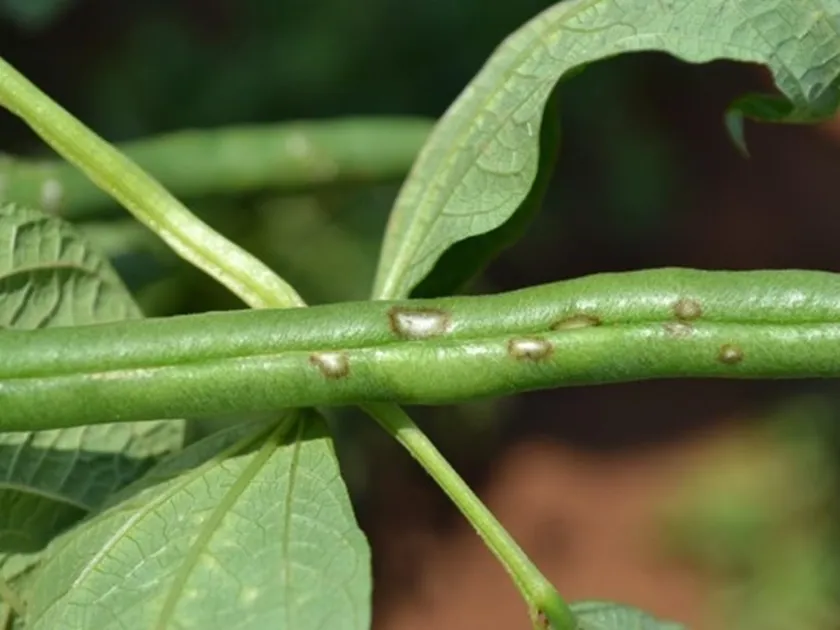
Pods show small, circular, sunken, dark brown spots. As the disease progresses, these spots enlarge and may merge, eventually covering the entire pod and preventing proper seed development.
Seeds within infected pods develop brown or black spots. If the infection occurs early, seeds may shrivel, discolor, or fail to germinate, serving as a primary source for the next season.
Pathogen
Bean anthracnose is caused by the fungus Colletotrichum lindemuthianum (teleomorph: Glomerella lindemuthiana). While older literature might mention Elsinoë phaseoli, modern plant pathology identifies C. lindemuthianum as the primary causal agent.
The pathogen persists in infected seeds, crop debris, and soil as mycelium. It is a highly variable fungus capable of producing new races that can overcome the resistance of previously stable bean varieties.
The life cycle involves the formation of conidia within structures called acervuli. These spores are disseminated by rain splashes, wind, and movement of equipment or workers through wet fields.
The fungus can infect seeds internally, where it remains dormant until germination. Planting infected seeds often results in pre-emergence death of seedlings or post-emergence lesions on hypocotyls.
Development is heavily dependent on moisture. Spore germination and infection require free water on plant surfaces and moderate temperatures, typically ranging from 15 °C to 22 °C.
Conditions for development
Cool, wet weather is the primary driver of anthracnose epidemics. Rain splash is the most efficient mechanism for spreading spores from the lower canopy to the upper parts of the plant.
High relative humidity (over 90%) and lack of air circulation in dense bean stands provide optimal conditions for the fungus to colonize plant tissues rapidly.
Continuous cropping of beans without proper rotation allows the pathogen to build up in the soil, significantly increasing the infection pressure for subsequent seasons.
Using untreated, saved seed is a major cause of disease outbreaks. The pathogen is efficiently carried on or within the seed coat, introducing the disease to new fields.
Over-fertilization with nitrogen, which promotes lush vegetative growth and denser canopies, indirectly creates a more favorable microclimate for the pathogen's spread.
Why it matters
Anthracnose can cause devastating losses, often reducing yields by 50% or more under favorable environmental conditions. It compromises both the quantity and marketability of the crop.
Early-season infection leads to poor stand establishment, often necessitating expensive replanting of the entire field and delaying the harvest timeline.
The quality of harvested seeds is severely degraded, making them unsuitable for consumption or commercial seed sale due to poor germination and unsightly staining.
Defoliation and necrosis reduce the plant's photosynthetic capacity, leading to weaker pods, smaller beans, and overall reduced biomass and plant vigor.
In humid regions, the disease can spread rapidly throughout a field within days, making late-season control very difficult and costly for farmers.
Protection
The most critical management practice is the use of disease-free, certified seed produced in arid or semi-arid regions where the fungus does not thrive.
Crop rotation for at least 3 years is essential to allow infected debris in the soil to decompose before planting beans again on the same site.
- Treat seeds with effective systemic fungicides before planting.
- Avoid working in bean fields when the foliage is wet to prevent spore spread.
- Deep plowing of crop residues immediately after harvest to reduce inoculums.
- Plant resistant or tolerant varieties adapted to the local region.
- Apply foliar fungicides during the growing season if symptoms are detected.
Discussion
No discussions yet — be the first.