
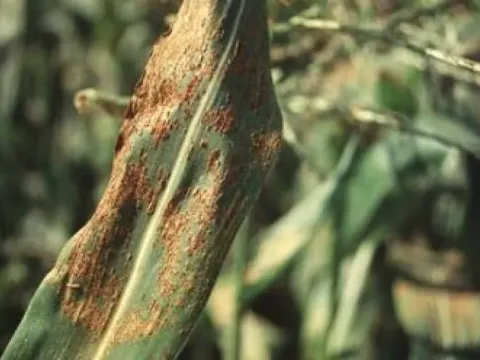
Southern corn rust
Physopella compressa
The causal agent of Southern corn rust is the obligate parasite fungus Physopella compressa (formerly known as Angiopsora zeae). This pathogen acts as a biotroph, extracting nutrients directly from the living tissue of the host plant.
What the section contains
Southern corn rust
The disease primarily affects maize and some related species. The fungus completes its life cycle within the host tissue, and in maize fields, the primary source of infection is the urediniospores, which can reinfect plants repeatedly during the growing season.
The biology of the pathogen depends entirely on the presence of living host tissue. The spores are dispersed by wind, allowing the fungus to travel significant distances from initial infection sites to healthy fields.
The fungus develops its mycelium within the leaf intercellular spaces, eventually forming fruiting structures known as pustules. These structures rupture the leaf epidermis to release spores into the environment.
This pathogen is categorized as a rust fungus, specifically targeting the leaf apparatus and disrupting vital physiological processes like respiration and photosynthesis.
The initial signs of infection are the appearance of small, chlorotic spots on the leaf surface. As the infection progresses, these spots develop into distinct pustules on both the upper and lower sides of the leaves.
The pustules are typically rust-colored or light brown, which gives the disease its characteristic name. They may appear individually or merge into streaks that follow the orientation of the leaf veins.
Severe infestations lead to extensive leaf yellowing and necrosis. As the disease advances, the leaves begin to dry out, often starting from the lower canopy and moving upward as the fungal load increases.
The plant appears stunted and unhealthy, with a dirty-brown appearance caused by the dense concentration of fungal spores. In later stages, dark streaks may appear, indicating the transition to the teliospore stage of the fungus.
Proper identification is crucial, as Southern corn rust may be confused with common rust (Puccinia sorghi). Careful observation of pustule shape and distribution is necessary for accurate field diagnosis.
The development of Physopella compressa is heavily favored by high humidity. Prolonged rainy weather, frequent heavy dews, and persistent fog create the perfect environment for spore germination on the leaf surface.
The optimal temperature range for the pathogen's development is between +20°C and +28°C. Under these favourable conditions, the incubation period is shortened, allowing for rapid disease spread across the field.
High plant density and restricted air circulation within the canopy create a microclimate with high humidity levels. This lack of airflow prevents leaves from drying quickly, which is a major factor in disease susceptibility.
Wind is the primary vector for the dispersal of fungal spores. Excessive nitrogen fertilization can also exacerbate the problem by promoting dense foliage growth, which makes the crop more susceptible to fungal infection.
Regions with warm and humid summers are most prone to epidemics, making monitoring during the vegetative and reproductive phases essential for agricultural management.
The primary damage caused by Southern corn rust is the significant reduction of the leaf area available for photosynthesis. This blockage severely impacts the plant's ability to produce carbohydrates for grain fill.
This results in lower thousand-kernel weight and reduced overall yield. The ears may be poorly filled, and the grains often become shriveled, which lowers the market grade and nutritional quality of the corn.
Premature senescence of the leaves cuts short the grain-filling period, which is critical for maximizing harvestable weight. Weakened plants are also more vulnerable to secondary infections, such as stalk and root rots.
The disease can lead to lodging of the crop, making mechanical harvesting difficult and causing further harvest losses. These impacts combined can cause substantial economic losses in high-pressure years.
In severe cases, yield losses can range significantly, sometimes exceeding 20-30% depending on the timing of the initial infection and the susceptibility of the hybrid planted.
The use of resistant or tolerant corn hybrids is the most effective and sustainable strategy for managing Southern corn rust. Genetic resistance remains the primary line of defense for growers.
Cultural practices, such as burying crop residues deeply, can help reduce the amount of primary inoculum in the field. Adhering to proper crop rotation helps break the disease cycle.
Managing plant density is crucial to ensure proper canopy airflow, which reduces the duration of leaf wetness and makes the environment less hospitable to fungal spore germination.
When monitoring indicates a threshold infection level, the application of fungicides, particularly those containing triazoles or strobilurins, can effectively suppress the disease and protect the yield potential.
- Regular field scouting starting from the early vegetative stages.
- Timely fungicide applications based on local economic thresholds.
- Balanced nutrient management to avoid excessive vegetative growth.