
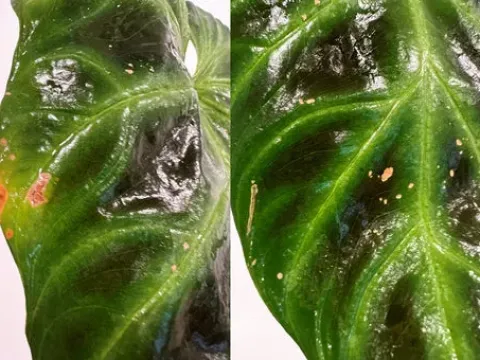
Phyllosticta leaf spot of philodendron
Phyllosticta philodendri
The disease is caused by the fungus Phyllosticta philodendri. This pathogen is a classic leaf-spotting fungus that colonizes the plant's tissues, primarily through natural openings like stomata.
What the section contains
Phyllosticta leaf spot of philodendron
The fungus survives on infected plant debris and in soil media, producing small fruiting bodies called pycnidia. These pycnidia act as persistent reservoirs for the next cycle of infection.
As the fungal mycelium grows within the leaf, it secretes enzymes that degrade plant cells, causing the characteristic necrotic lesions seen on the foliage.
The life cycle involves the release of pycnidiospores from pycnidia. These spores are splash-dispersed by water droplets during overhead irrigation or rainfall, spreading the infection to healthy leaves.
This pathogen is highly specialized and is particularly successful at infecting philodendrons in greenhouse or home environments where humidity levels remain consistently high.
The primary symptom is the appearance of small, circular to irregular spots on the leaves. Initially, these spots are tan or light brown and may have a yellowish halo.
Over time, the spots enlarge and turn dark brown or grey. A distinct feature is the presence of tiny, black specks within the center of these spots, which are the fungal pycnidia.
As the lesion matures, the central dead tissue may become brittle and crack, eventually falling out. This creates a "shot-hole" appearance, common in advanced stages of the disease.
If the infection is severe, the lesions may coalesce, leading to large areas of necrotic tissue. This causes the entire leaf to curl, wither, and eventually drop from the plant.
While primarily a foliage disease, if left untreated, the fungus can progress to petioles, causing the leaves to droop and fail, which significantly impacts the plant's structural integrity.
The disease thrives in warm and humid conditions, which are typical for indoor philodendron cultivation. Relative humidity above 70% significantly increases the risk of outbreak.
Temperatures between 22°C and 28°C provide the optimal climate for the rapid germination of fungal spores. These ranges are common in residential and greenhouse settings.
Persistent moisture on the leaf surface is a critical environmental trigger. Overhead watering or misting plants, especially in poorly ventilated rooms, ensures the spores can colonize the plant.
Poor sanitation, such as failing to remove fallen, diseased leaves from the soil surface, allows the pathogen to cycle continuously within the potting environment.
Over-fertilization with nitrogen can create soft, succulent leaf tissue that is much more susceptible to the penetration of the fungus compared to naturally toughened leaves.
The most immediate harm is the destruction of the plant's aesthetic value. The foliage becomes disfigured, which is unacceptable for a plant kept primarily for its ornamental leaves.
Reduced photosynthetic capacity is a significant physiological consequence. As large areas of the leaves die, the plant struggles to produce sufficient energy for growth, leading to stunted development.
The plant suffers from increased stress, making it susceptible to secondary infections, such as bacterial soft rots or opportunistic pests that exploit the weakened tissues.
There is a constant risk of the disease spreading to other plants in the collection. Once established, the fungus can persist on tools and surfaces, making it difficult to eradicate completely.
In extreme cases, the plant can lose a significant portion of its canopy, leading to irreversible decline and potential death of the philodendron if the crown becomes affected.
Sanitation is the first line of defense. Promptly remove and discard all infected leaves. Do not compost this material, as the spores can survive standard composting temperatures.
Improve air circulation around the plants to ensure the foliage remains dry. Increasing the distance between pots can help prevent the spread of spores from one plant to another.
Adjust watering practices to avoid wetting the foliage. Water only at the soil base, and ensure the soil is well-draining to prevent excess humidity around the plant base.
Fungicidal applications are necessary for severe infestations. Copper-based fungicides or systemic options containing tebuconazole or myclobutanil are effective at stopping the spread of the fungus.
Implementing biological control agents, such as beneficial bacteria (e.g., *Bacillus subtilis*), can help create a protective barrier on the leaf surface and improve the overall plant health.