
Pholiota adiposa
Pholiota adiposa
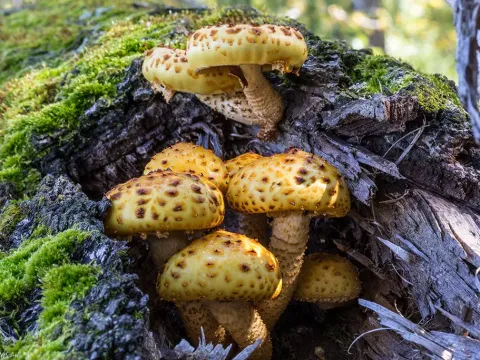
Pholiota adiposa manifests through the growth of fruiting bodies on the trunks and stumps of deciduous trees. These mushrooms have a characteristic yellowish-brown, sticky or slimy cap covered with dark scales.
What the section contains
Pholiota adiposa
External signs of infection often become visible only when fruiting bodies appear en masse. Under the bark, in the area of infection, one can find extensive mycelium penetrating deep into the wood structure.
The tree tissues in the zone of mycelial development change color, becoming soft and friable. Over time, the affected areas lose structural integrity, leading to trunk deformation and deep fissures.
In later stages, large patches of peeling bark reveal white or yellowish fungal tissue underneath. There is also a noticeable decline in the canopy, premature leaf drop, and drying out of individual branches.
The fruiting bodies themselves are the main danger as they act as a source of spore dispersal. They tend to grow in dense clusters at the base of the trunk, which is a clear indicator of extensive internal wood decay.
The pathogen is Pholiota adiposa, a wood-decay fungus that belongs to the group causing white rot, which actively decomposes lignin and cellulose.
This fungus acts primarily as a saprotroph but can also be parasitic on weakened trees, effectively dismantling the structural components of the wood.
Fungal spores penetrate the tree through mechanical injuries to the bark, pruning wounds, frost cracks, or broken branches. This allows the pathogen to colonize the inner layers of the trunk quickly.
The mycelium spreads gradually through the vascular tissues, effectively depriving the tree of its ability to transport nutrients and water efficiently.
The biological cycle of Pholiota adiposa is closely linked to environmental humidity, as the fungus requires significant moisture to produce its fruiting bodies.
The development of Pholiota adiposa is most intense in conditions of high air humidity and moderate temperatures, typically found in shaded forests or orchards.
The fungus predominantly affects trees already weakened by other stressors, such as drought, pest infestations, or unfavorable climatic conditions.
The presence of fresh wounds on the trunk or unprotected pruning cuts acts as a critical entry point, facilitating the access of fungal spores into healthy wood.
Water stagnation at the base of the trunk or poor air circulation on the site contributes to faster mycelial growth and fruiting body formation.
Old, over-mature stands of deciduous species like birch, aspen, or beech serve as primary reservoirs of the infection in natural environments.
The primary damage caused by Pholiota adiposa is the destruction of the wood's structural integrity, making the tree extremely vulnerable to windthrow.
The infected tree gradually loses its vitality and productivity, eventually leading to its death and the senescence of individual parts of the canopy.
For forestry and arboriculture, this represents significant losses in wood quality, as it becomes unsuitable for use due to advanced rot.
The fungus can spread rapidly within a stand, moving from one tree to another through root contacts or airborne spores.
Infection by this pholiota reduces the overall aesthetic and biological value of forest plots, turning them into epicenters for further disease spread.
The primary method of prevention is thorough tree care and prompt treatment of all wounds and pruning cuts with antiseptic agents or specialized wound dressings.
Regular sanitary maintenance of the garden, including the removal of dead or fungus-infected branches, significantly reduces the infectious pressure.
It is necessary to cull and remove heavily infected trees promptly, including the extraction of stumps, as they often serve as a long-term source of reinfection.
- Ensuring optimal nutrient levels for plants to support their natural immunity.
- Performing pruning operations during dry weather to minimize the risk of spore transmission.
- Improving drainage on the site to prevent excessive soil and base moisture.
If fungicides are necessary, systemic formulations should be prioritized; however, their efficacy against wood-decay fungi is limited and is generally only effective during the very early stages of infection.