
Pholiota limonella
Pholiota limonella
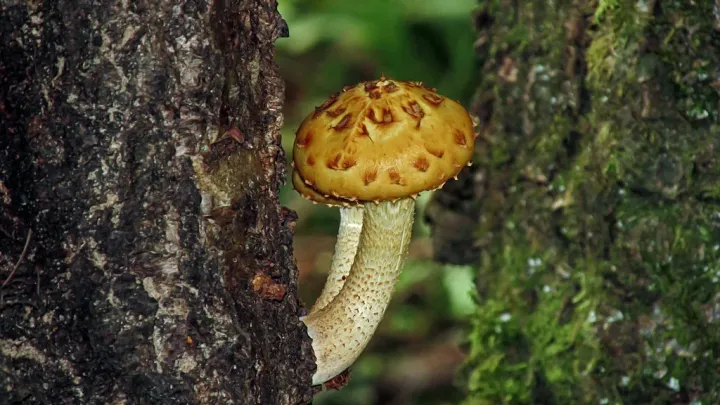
Description
Symptoms
The most visible sign of infection is the emergence of dense clusters of bright yellow mushrooms directly on the tree trunk or root flare. Their distinct color makes them easily identifiable in woodland environments.
Internally, the wood undergoes structural degradation, becoming soft, fibrous, and pale in color. This characteristic whitening is a classic symptom of white rot caused by the decomposition of wood cell wall polymers.
External symptoms often include bark peeling or cracking in the vicinity of fungal activity. Beneath the bark, one can often find white mycelial fans penetrating the cambium and phloem layers.
Affected trees typically show signs of decline, such as thinning crowns, yellowing of foliage, or premature leaf drop, as the fungal growth disrupts the tree's vascular system and nutrient transport.
Advanced stages of decay result in the formation of deep hollows or cavities within the trunk. These structural defects severely compromise the mechanical stability of the tree, creating a risk of breakage.
Pathogen
Pholiota limonella is a wood-decay fungus belonging to the Strophariaceae family. It typically functions as a saprotroph but can act as a facultative parasite, attacking weakened or injured living trees.
The pathogen is a cause of white rot in timber. The mycelium invades the tree through bark wounds, pruning cuts, or frost cracks, gradually breaking down lignin and cellulose within the wood structure.
Biologically, the fungus is characterized by the production of bright yellow fruiting bodies with distinct scales. These fruiting bodies serve as primary sources of spores, which are disseminated by wind and insects across forest areas.
Unlike specialized pathogens, Pholiota limonella displays a wide range of host tree species, making it highly resilient. It can survive in dead wood for long periods, maintaining a persistent inoculum source.
The life cycle is closely linked to moisture levels and ambient temperatures. It thrives in moderate conditions, with mycelial growth accelerating during wet spring and autumn seasons, which are critical for its spread.
Conditions for development
The primary prerequisite for infection is the presence of physical injuries. Mechanical wounds provide the necessary entry points for spores to bypass the tree's natural protective barriers and reach the inner wood.
High humidity is a critical factor for spore germination and mycelial colonization. Forest stands with dense canopy cover and poor air circulation provide the perfect microclimate for the fungus to flourish.
Tree stress, induced by drought, waterlogging, or pest infestation, significantly reduces host resistance. Stressed trees are unable to compartmentalize the infection, allowing the fungus to colonize the trunk rapidly.
An abundance of woody debris, such as logs and stumps, acts as a reservoir for the pathogen. Failure to implement forest sanitation practices results in an increased inoculum pressure that threatens healthy neighboring trees.
Temperature fluctuations that maintain high moisture on the bark surface are optimal for fungal development. In such environments, the rate of colonization increases significantly, leading to faster degradation of the timber.
Why it matters
The main danger posed by Pholiota limonella is the rapid destruction of the heartwood, which reduces the timber's physical strength and economic value, rendering it unsuitable for commercial use.
Structural weakening of the trunk increases the danger of windthrow and sudden stem breakage. This poses a significant safety hazard, especially in urban parks, residential areas, and along forest paths.
Infection leads to physiological decline, characterized by slowed growth and reduced vigor. Over time, the cumulative impact of the fungus often leads to the death of the tree.
Infected trees often become susceptible to secondary infestations by wood-boring insects, further accelerating the process of decay and the eventual collapse of the individual plant.
The economic impact involves the loss of valuable forest resources, the costs associated with the removal of hazardous trees, and the degradation of the landscape’s aesthetic and recreational value.
Protection
The foundation of effective control is regular forest sanitation, which involves the prompt identification and removal of infected trees and stumps to limit the spread of spores.
Preventive measures focus on minimizing mechanical damage to trunks during forestry operations. Any accidental wounds must be treated immediately with antiseptic sealants to block pathogen entry.
When pruning trees, it is essential to use proper techniques and treat large cuts with fungicides or specialized wound dressings. This prevents the colonization of exposed heartwood by fungal spores.
Improving the ventilation and sunlight penetration within stands creates a less favorable environment for fungi. Maintaining overall tree health through proper species selection and spacing is also vital.
- Systematic monitoring of tree stands for fungal fruiting bodies.
- Prompt disposal of infected woody material.
- Disinfection of tools and cuts during pruning.
- Enhancing forest sanitation by clearing accumulated debris.
Discussion
No discussions yet — be the first.