
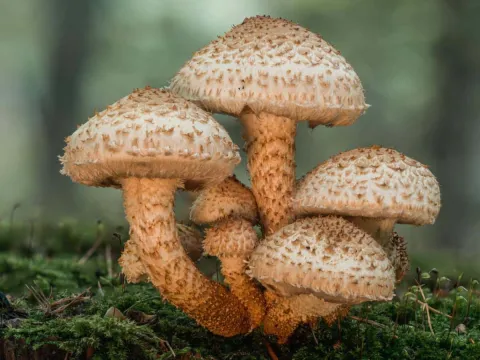
Pholiota
Pholiota
The genus Pholiota consists of saprotrophic and parasitic fungi belonging to the Strophariaceae family. In agricultural and arboricultural contexts, these fungi are recognized as significant agents of white or brown rot in woody plants.
What the section contains
Pholiota
The pathogen typically invades through existing wounds, broken branches, frost cracks, or pruning sites. Once established, the mycelium penetrates deep into the xylem and sapwood.
These fungi produce enzymatic complexes capable of degrading lignin and cellulose, which are essential components of the cell wall structure in trees, leading to structural instability.
Pholiota species have a sophisticated life cycle, producing fruiting bodies (mushrooms) that release vast quantities of spores, allowing for rapid dispersal by wind and water.
The mycelium can remain dormant or active in deadwood or stumps for many years, creating long-term reservoirs of infection within the orchard or forest environment.
The most distinctive sign of Pholiota infection is the emergence of dense clusters of scaly fruiting bodies on the trunk, branches, or near the base of the tree.
Internally, the wood becomes discolored, fragile, and soft. Advanced stages of decay often result in the formation of large, hollow cavities within the heartwood of the tree.
Symptoms in the canopy include premature yellowing or wilting of leaves, reduced shoot growth, and an overall lack of vigor in the affected tree.
Bark abnormalities, such as cracks, peeling, or localized seepage of sap, are common near the sites where the fungus is most active.
A dull sound when tapping the trunk or main branches indicates that the internal structural integrity has been compromised by the fungal mycelium.
The development of Pholiota is highly moisture-dependent. High relative humidity and damp wood provide the necessary environment for mycelial expansion and colonization.
Optimal temperatures for the growth of Pholiota mycelium generally range between 18°C and 25°C, making the growing season a period of high vulnerability.
Poor ventilation and overcrowded planting patterns create microclimates that encourage spore germination and fungal establishment on bark surfaces.
Trees that have suffered from environmental stress, such as drought, sunscald, or mechanical injury, are significantly more susceptible to successful colonization.
Lack of proper sanitation practices, such as failing to remove decaying woody debris or untreated pruning wounds, allows the fungus to thrive and spread.
The primary concern with Pholiota is the degradation of the tree's mechanical structure, which increases the risk of limb failure and windthrow during storms.
In orchards, the physiological stress caused by the infection leads to reduced fruit yield and lower quality produce, significantly impacting economic returns.
Severe infestations are often irreversible, eventually killing the tree and necessitating costly removal and stump treatment protocols.
The fungus acts as a source of inoculum that can spread to healthy trees, potentially triggering localized outbreaks within a collection or plantation.
The loss of mature trees represents a long-term setback, as replanting and reaching the same level of productivity can take many years.
Management of Pholiota emphasizes proactive prevention and early intervention to limit the spread of the pathogen within the environment.
- Regular inspection of trees for early signs of fruiting body formation or bark anomalies.
- Prompt removal and destruction of all fruiting bodies before they release spores.
- Strict adherence to sanitation practices, including painting all pruning wounds with protective fungicides or sealants.
- Removing severely infected trees, including the entire root system, to prevent spread through underground mycelial contact.
- Implementing a robust fertility and irrigation program to keep trees healthy and more resilient to fungal attacks.