
Downy mildew of hop
Paraperonospora minor
The first symptoms appear in early spring on young shoots, which become stunted and brittle, often referred to as "spikes". These shoots have shortened internodes and deformed, downward-curled leaves.
What the section contains
Downy mildew of hop
A characteristic grey or violet-grey downy growth appears on the underside of infected leaves, consisting of the pathogen's sporangiophores. In high humidity, this growth becomes very dense and clearly visible.
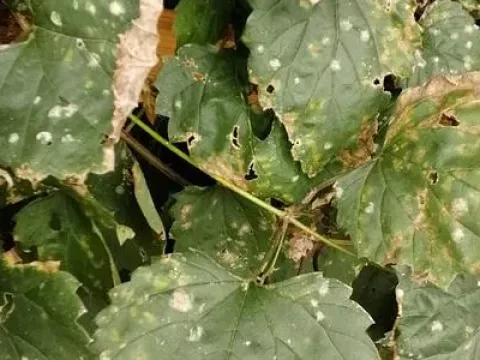
On older leaves, symptoms appear as angular, yellow-to-brown spots confined by leaf veins. Over time, these areas become necrotic, leading to leaf distortion and premature leaf drop across the canopy.
When the infection spreads to the flowers and cones, it causes deformation and browning. Infected cones become withered, lose their brewing quality, and are often rendered completely unsuitable for harvest.
Systemic infection leads to a general decline in the plant's health, characterized by stunted growth and lack of vigor. In severe cases, the entire vine may collapse due to the weakening of vascular tissues.
The disease is caused by the oomycete Pseudoperonospora humuli. It is a highly specialized pathogen that exclusively infects wild and cultivated Humulus lupulus.
The pathogen overwinters as mycelium within the hop crowns (rhizomes). In early spring, the mycelium grows into the developing buds, establishing a systemic infection that follows the plant's growth.
During the growing season, the pathogen reproduces via zoospores produced in sporangia. These zoospores are motile in films of free moisture, allowing them to swim and infect healthy leaves and shoots rapidly.
In addition to mycelium, the pathogen can produce oospores, which are thick-walled resting spores. These allow the fungus to survive in soil and organic matter, acting as a potential reservoir for future infections.
The biological cycle of the pathogen is strictly dependent on moisture availability. Free water is required on the leaf surface for at least several hours to allow the zoospores to germinate and penetrate the tissue.
Downy mildew development is favored by cool to moderate temperatures and high humidity. Optimal conditions for infection are temperatures between 15°C and 20°C combined with relative humidity above 90%.
Frequent rain events, heavy morning dews, and prolonged fog are critical for the dispersal and survival of zoospores. These conditions can trigger rapid outbreaks in commercial hop yards.
Poor canopy ventilation, often caused by high planting density, prevents leaves from drying quickly after rainfall. This persistent moisture creates a microclimate that is ideal for the pathogen's development.
Poor management practices, such as lack of weed control or failure to strip lower leaves, contribute to the humidity buildup within the lower parts of the plant, increasing susceptibility.
Over-fertilization with nitrogen can lead to rapid, lush growth of succulent tissues, which are more easily penetrated by the pathogen compared to hardier, slower-grown foliage.
Downy mildew is considered the most devastating disease for hop production worldwide. Under favorable conditions, it can cause total crop loss if left uncontrolled.
Infection significantly reduces the photosynthetic capacity of the vines, which weakens the rhizomes and lowers the overall yield potential and plant health for subsequent seasons.
The economic impact is manifested through reduced yield and impaired chemical profiles of the cones, specifically lower levels of alpha-acids and essential oils, which are critical for brewing.
Systemic damage to the crowns can lead to plant death, resulting in thin, unproductive stands that require costly replanting to restore the hop yard's efficiency.
The ongoing costs associated with repeated fungicide applications and intensive labor for disease management represent a major financial burden for hop farmers.
The most sustainable strategy for disease management is the use of resistant hop cultivars, which effectively reduces the reliance on chemical control methods.
Early scouting and the manual removal of "spikes" are crucial. By eliminating these sources of primary inoculum early in the season, growers can significantly delay or minimize disease spread.
Fungicide programs should be based on weather monitoring and risk assessment. Protective treatments using copper-based or systemic fungicides are essential during high-pressure periods.
Cultural practices are vital, including maintaining appropriate plant spacing for airflow, pruning lower leaves to reduce humidity, and strictly controlling weeds to improve site ventilation.
Improving soil drainage and optimizing irrigation methods help to maintain a drier environment within the hop yard, which directly limits the mobility of zoospores and inhibits the pathogen's cycle.