
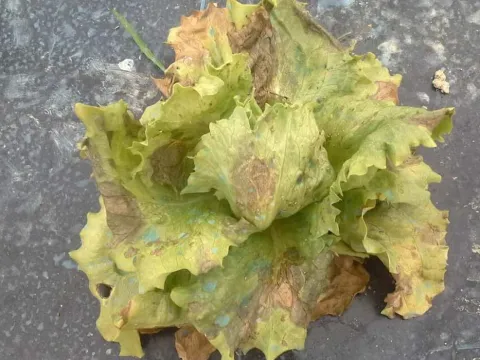
Downy mildew of lettuce
Bremia
The pathogen responsible for this disease is the oomycete Bremia lactucae, which belongs to the Peronosporaceae family and is an obligate parasite of lettuce.
What the section contains
Downy mildew of lettuce
The pathogen is highly variable and capable of overcoming host resistance through the continuous formation of new physiological races, presenting a major challenge for plant breeding.
It survives in the soil as oospores, which can remain viable for several years, and can also be found on weed hosts within the Asteraceae family.
Reproduction occurs mainly through conidia, which are easily wind-dispersed, allowing the pathogen to spread across large geographical areas in a relatively short time.
In wet conditions, conidia germinate to release motile zoospores, which utilize water films to migrate to the stomata of the lettuce leaf to initiate infection.
The initial symptoms are characterized by chlorotic, yellow-green spots appearing on the lower leaves, typically bounded by leaf veins, creating a distinct angular pattern.
A definitive diagnostic sign is the appearance of a white, fluffy fungal growth on the underside of the leaves, corresponding exactly to the locations of the yellow lesions.
As the disease progresses, these lesions turn necrotic and brown, causing the entire leaf tissue to collapse and wither, significantly reducing the plant's photosynthetic capacity.
Seedlings infected with downy mildew often exhibit stunting, yellowing, and may die off completely if the environmental conditions remain favorable for the pathogen.
On mature plants, the presence of the fungal layer renders the harvested lettuce unacceptable for commercial sale due to severe aesthetic and quality degradation.
The disease thrives in cool, humid environments, with optimal infection occurring at temperatures between 15 and 20 degrees Celsius and relative humidity above 85 percent.
The presence of free moisture, such as dew or mist, on the leaf surface is a critical requirement for the germination of spores and the penetration of the host tissue.
Greenhouse environments with poor ventilation or high planting densities often lead to stagnant air, promoting the rapid spread of the pathogen through the canopy.
Frequent overhead irrigation increases the risk of outbreaks as it provides necessary moisture and helps mechanically disseminate the spores between neighboring plants.
Long-term survival of the pathogen in the field is bolstered by the continuous cultivation of lettuce without adequate rotation, which builds up the oospore population.
The economic impact of lettuce downy mildew is primarily due to the loss of marketable yield and the high cost associated with implementing intensive fungicide programs.
Infected leaves are highly susceptible to secondary colonization by bacteria and other decay organisms, leading to post-harvest losses and reduced shelf life.
A severe epidemic can result in total crop failure, particularly in regions where environmental conditions favor the pathogen during the most vulnerable stages of plant development.
The pathogen's ability to quickly evolve renders once-resistant cultivars ineffective, forcing producers to constantly seek new germplasm for their production cycles.
Market requirements for cosmetic perfection in lettuce products mean that even minor symptoms can result in the rejection of entire harvests during quality control inspections.
The primary control strategy involves the use of resistant lettuce cultivars, though breeders must constantly update these to combat the emergence of new pathogen races.
- Implement drip irrigation to maintain dry foliage and reduce humidity near the canopy.
- Ensure adequate spacing between plants to improve airflow and facilitate rapid drying of leaves.
- Practice crop rotation with non-host species to reduce the levels of soil-borne inoculum.
- Remove and destroy all crop residues and susceptible weeds immediately after harvest.
- Use greenhouse climate control systems to keep humidity levels low during critical infection periods.
Fungicides with systemic or contact activity can be applied as a preventive measure, ensuring that rotation of modes of action is practiced to avoid fungicide resistance.
Regular scouting of crops for early symptoms is essential to allow for timely interventions, preventing the disease from reaching epidemic proportions in the production field.