
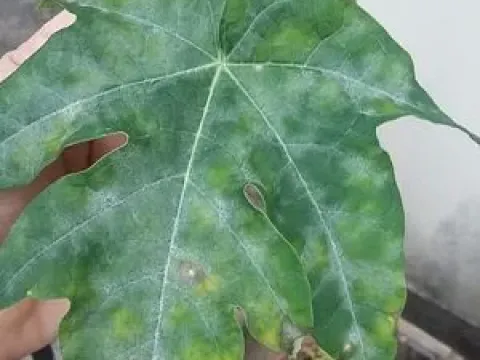
Indian powdery mildew
Oidium indicum
The causal agent of this disease is the fungus Oidium indicum, a member of the Erysiphales order known for causing powdery mildew infections on various plant species.
What the section contains
Indian powdery mildew
It is an obligate parasite, meaning it requires living host tissue to complete its life cycle and cannot survive on dead organic matter for extended periods.
The fungus develops a superficial mycelium on the surface of the host, sending haustoria into the epidermal cells to extract nutrients for its growth and reproduction.
Reproduction is primarily asexual, involving the production of numerous conidia that are easily dispersed by wind, splashing water, or mechanical contact.
The pathogen overwinters as mycelium on dormant buds or in infected plant debris, ensuring a rapid re-emergence of the disease when favorable conditions return.
The most visible symptom is the development of a white, powder-like fungal growth that appears as patches on leaves, stems, and occasionally flower petals.
As the infection progresses, the powdery spots expand and merge, eventually covering large portions of the plant tissue, which restricts sunlight absorption.
Underneath the fungal mat, the plant tissue often becomes chlorotic, taking on a pale yellow or necrotic appearance as the cells are drained of their contents.
Severe infestations lead to leaf curling, stunted growth of new shoots, and premature senescence or shedding of leaves, which weakens the plant significantly.
Flowers and fruit may also be covered by the white mass, leading to malformation, reduced size, and a significant loss in market quality of the produce.
Indian powdery mildew thrives in environments with high humidity and moderate temperatures, which are common during spring and early summer months.
The optimal temperature range for the rapid germination of conidia and vegetative growth of the fungus is typically between 18 and 25 degrees Celsius.
Dense canopies, high planting density, and poor air circulation create stagnant microclimates that promote disease spread by trapping moisture near the foliage.
Excessive nitrogen fertilization often leads to lush, succulent growth, which is more susceptible to fungal penetration and rapid colonization by the pathogen.
Fluctuating temperatures and nocturnal dew formation provide the necessary hydration for the fungus to persist and replicate efficiently on host surfaces.
The disease causes substantial yield losses by disrupting the photosynthetic capacity of the plants, resulting in lower sugar content and smaller fruit size.
Plants affected by Oidium indicum show reduced vigor and resilience, making them less capable of tolerating environmental stressors like drought or heat.
The aesthetic value of ornamental plants is destroyed, rendering them unfit for commercial sale due to the unattractive white fungal covering on leaves and buds.
In perennial crops, the accumulation of the pathogen year after year can lead to systemic decline, reduced longevity of the plant, and increased risk of winter kill.
The cost of constant fungicide applications and labor-intensive sanitation practices adds significant financial pressure on agricultural operations.
Effective management relies on an integrated approach, starting with the removal and destruction of infected plant material to reduce the primary inoculum.
Cultural practices like pruning for air circulation and avoiding overhead irrigation can significantly lower the humidity levels around the foliage.
Application of fungicides, such as sulfur-based products, systemic triazoles, or strobilurins, should be timed based on regular monitoring of field conditions.
Promoting general plant health through balanced nutrient management helps boost natural defenses and reduces the severity of the infection.
- Selecting resistant varieties where available.
- Maintaining proper spacing between plants.
- Monitoring fields for early signs of white mycelium.
- Rotating chemical classes to prevent resistance development.
- Sanitizing tools to prevent cross-contamination between plants.