
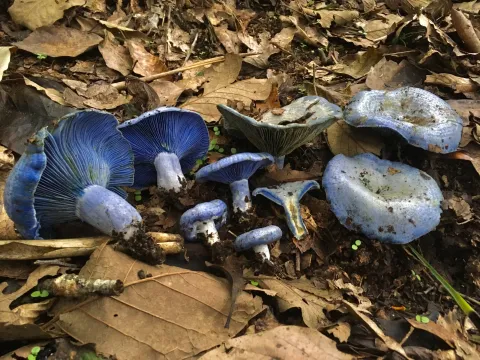
Indigo milk cap
Lactarius indigo
Lactarius indigo is a species of edible mushroom in the Russulaceae family and is not a plant pathogen.
What the section contains
Indigo milk cap
This fungus exists as an ectomycorrhizal partner, forming symbiotic relationships with the roots of various tree species.
It does not infect crops, nor does it cause any diseases, lesions, or biological stress to agricultural vegetation.
Its life cycle revolves around the exchange of nutrients with forest trees, contributing to the health of the ecosystem.
Misclassifying this beneficial fungus as a plant disease is inaccurate from an agronomic and scientific perspective.
The mushroom is recognized by its striking dark blue to indigo color, which is consistent across the cap, gills, and stipe.
When the tissue is cut or damaged, it exudes a vivid indigo-blue latex that slowly turns greenish upon exposure to air.
The cap typically features a funnel shape with a rolled margin when young, and it can grow up to 15 centimeters in diameter.
The gills are crowded and decurrent, contributing to the distinct aesthetic appearance of the fruiting body.
The stipe is solid and often covered with shallow pits, maintaining the characteristic blue pigmentation found elsewhere.
Indigo milk caps thrive in moist, well-drained forest environments where they can associate with host tree species.
They require significant rainfall and high humidity to initiate the development of their fruiting bodies from the soil.
Temperatures ranging from mild to warm (approximately 15–22 degrees Celsius) are ideal for the development of the mycelium.
The fungus prefers organic-rich forest soils where the mycorrhizal network can easily connect with root systems.
Distribution is determined by the presence of specific trees, such as oaks and pines, which serve as essential symbiotic partners.
This species poses absolutely no threat to crops, vegetables, fruits, or any other commercial agricultural plant life.
Instead, it acts as a beneficial organism, supporting tree vitality through enhanced nutrient and water uptake.
It carries no pathogenic risk, making it completely harmless to the agricultural sector and backyard gardening.
The mushroom provides no mechanism to cause plant decline, stunted growth, or any other type of agricultural loss.
Ecologically, its role is restricted to forest ecosystems where it serves as a decomposer and a symbiont.
As the Indigo milk cap is not a plant disease or a pest, no protective or control measures are necessary.
Fungicides should never be applied against this species, as it is a natural component of forest biodiversity.
Management efforts should focus on preserving the woodland habitats where this fungus naturally occurs.
There are no eradication protocols or preventative strategies required for this fungus in any agricultural setting.
The species is considered environmentally beneficial, and its natural growth cycle should be encouraged rather than restricted.