
Naohidemyces
Naohidemyces
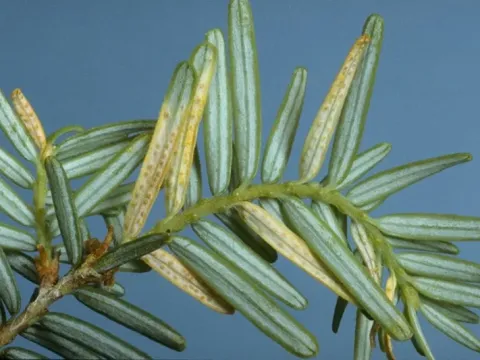
A primary sign of Naohidemyces infection is the appearance of distinct rust-colored structures on the needles. During the sporulation period, small, slightly raised cushions or pustules, often yellow or orange, emerge on the affected needle surfaces.
What the section contains
Naohidemyces
Heavily infected needles eventually turn yellow or brown, lose their natural elasticity, and become brittle. This process ultimately leads to premature needle cast, significantly reducing both the aesthetic value and the overall vitality of the conifer species.
Upon closer inspection of the needle underside, one can observe ruptures in the epidermis through which the pathogen's aeciospores are released. These structures often form in rows along the central vein or across the entire needle surface, creating a characteristic rusty appearance.
Infection often occurs in patches, spreading from the lower branches upward through the tree canopy. In high humidity, visual symptoms become more pronounced due to the mass maturation and dispersal of fungal spores.
During later stages of the disease, necrotic spots may appear on the needles, eventually merging to cover the entire needle area, which leads to rapid desiccation and death of the foliage.
The disease is caused by the fungus Naohidemyces, a member of the rust fungi group. It is a highly specialized parasite that often follows a complex life cycle involving host alternation, which is typical for members of this taxonomic order.
As an obligate parasite, the fungus derives nutrients exclusively from living host plant tissues. It achieves this by forming specialized organs known as haustoria, which penetrate the host needle cells to facilitate nutrient uptake.
The pathogen's life cycle involves the formation of various spore stages, which ensure the fungus's survival under diverse environmental conditions and provide the ability to disperse effectively across landscapes.
The primary hosts for Naohidemyces are various species of spruce (Picea). The fungus localizes within the needle tissues, causing profound disruption to physiological processes such as photosynthesis and transpiration.
The fungal mycelium is capable of penetrating deep into plant tissues, ensuring the long-term persistence of the pathogen within the host organ and enabling the annual production of new infectious material.
The development of Naohidemyces is directly linked to air humidity levels and the frequency of precipitation during the spring and summer. High moisture levels facilitate spore germination and their subsequent dispersal by wind and rain splash.
Optimal temperature ranges for the fungus typically coincide with the period of active needle growth in spruce trees, making juvenile tissues particularly vulnerable to infection during the spring flush.
Densely planted areas and inadequate canopy ventilation create a microclimate characterized by stagnant, humid air, which significantly accelerates the infection process and the rapid spread of the disease within the stand.
The presence of alternate hosts in the immediate vicinity of spruce trees significantly elevates the risk of epiphytotics by allowing the fungus to complete its full biological life cycle.
In years characterized by prolonged, wet spring weather, the intensity of Naohidemyces symptoms increases significantly, making environmental monitoring a crucial factor in forecasting potential disease outbreaks.
The primary damage caused by Naohidemyces is premature needle loss, which weakens the tree. Severe defoliation reduces the photosynthetic surface area, negatively impacting the growth rates and overall vigor of spruce trees.
Chronic infection over several years can lead to cumulative exhaustion, rendering the tree susceptible to secondary pests, opportunistic pathogens, and various abiotic environmental stressors.
For ornamental plantings and nurseries, Naohidemyces presents a serious concern as it severely diminishes the aesthetic quality of conifers, rendering them unsuitable for landscape design and commercial sale.
In forested areas, widespread rust outbreaks lead to reduced stand productivity and degraded forest health, necessitating large-scale silvicultural interventions to manage and contain the spread of the disease.
Stressed and weakened trees lose their ability to withstand environmental extremes, such as severe drought or hard frost, which can result in tree mortality under unfavorable conditions.
Effective management of Naohidemyces begins with good silvicultural and horticultural practices. Regular sanitary pruning and the removal of heavily infected branches are recommended to reduce the local inoculum source.
It is essential to maintain optimal stand density to ensure adequate airflow through the canopy, which minimizes the formation of the humid microclimates that favor fungal growth.
The application of chemical fungicides, particularly copper-based formulations or systemic triazole fungicides, can effectively suppress infection development during periods of high disease pressure.
Preventive fungicide applications should be timed for the early spring, coinciding with needle development stages and localized weather forecasts, to provide a barrier against initial infection.
- Prompt removal and disposal of fallen, infected needles from the site.
- Utilization of high-quality, disease-resistant plant material.
- Strict adherence to quarantine protocols when introducing new nursery stock to the area.