
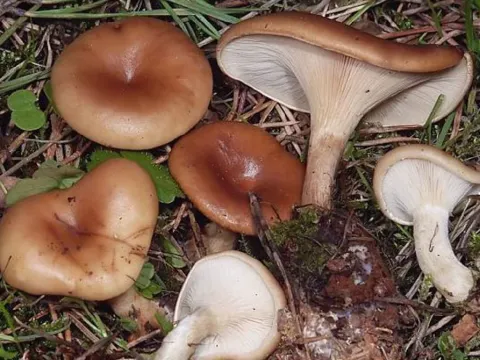
Tawny funnel
Lepista flaccida
The Tawny funnel (lat. Lepista flaccida) is a basidiomycete fungus belonging to the Tricholomataceae family.
What the section contains
Tawny funnel
It is primarily a saprotrophic organism that plays a significant role in breaking down organic matter, such as leaf litter and pine needles, in forest ecosystems.
While not a primary plant pathogen, it acts as a competitor in soil environments, potentially interfering with the symbiotic relationship between trees and mycorrhizal fungi.
The fungus develops an extensive mycelial network that can occupy large surface areas of the soil, influencing the local microbial composition.
In silviculture, its presence is often monitored to ensure it does not compromise the health and development of young forest stands.
A classic sign of Lepista flaccida is the formation of fairy rings, which are visible circles of mushrooms or altered vegetation growth on the forest floor.
The fruiting bodies feature a distinct reddish-brown, funnel-shaped cap that is easily recognizable to foresters and mycologists alike.
The gills are typically crowded and decurrent (running down the stem), which serves as a critical morphological characteristic for identification.
Visible white or cream-colored mycelium mats can often be found beneath the layer of decomposing organic material in the soil.
Symptoms in the nursery may include patches of stunted growth in seedlings located within the active expansion zone of the fungal colony.
The Tawny funnel thrives in environments with high moisture levels and a substantial layer of organic detritus, common in conifer-dominant forests.
Acidic soil conditions are particularly favorable for this species, supporting the rapid colonization of leaf litter and pine needle mats.
Autumnal cooling coupled with persistent dampness creates the ideal conditions for the mass appearance of fruiting bodies across the soil surface.
Poor drainage and soil compaction contribute to the establishment of the fungus, as it can readily colonize stagnant, high-organic environments.
Low levels of competition from other fungi allow Lepista flaccida to dominate the substrate and form expansive, long-lasting rings.
The primary concern regarding this fungus is its competitive nature, as it can suppress the growth of beneficial mycorrhizal fungi essential for tree health.
In nursery conditions, intensive mycelial growth can physically obstruct root access to vital nutrients and water, impacting seedling survival rates.
The biological activity of the fungus alters the soil chemistry, which may temporarily inhibit the development of sensitive plant species in the vicinity.
While it does not usually attack healthy, established trees, it can exploit weakened nursery stock, exacerbating existing stress factors.
Prolonged presence of the fungus in tree plots may lead to nutrient depletion in the topsoil layers due to rapid decomposition cycles driven by the mycelium.
Effective management includes the removal of excess organic litter in nurseries to reduce the available substrate for fungal colonization.
Soil aeration and improving drainage are essential cultural practices to discourage the growth of moisture-loving fungal colonies.
Strategic soil cultivation, such as turning the earth, can disrupt the mycelial network and prevent the expansion of fairy rings.
Monitoring the soil pH and adjusting it to levels less favorable for Lepista flaccida can be a long-term preventive strategy.
In specific cases where nursery seedlings are at risk, bio-fungicides that target competitive saprotrophs may be utilized under professional guidance.