
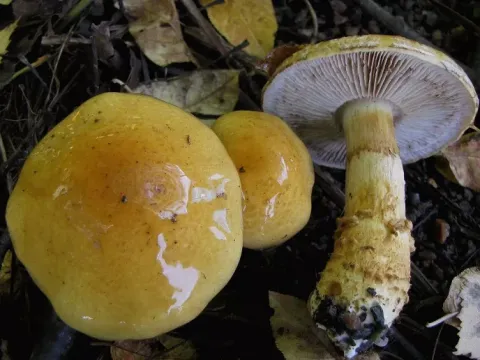
Tawny webcap
Cortinarius allutus
The Tawny webcap (Cortinarius allutus) is a basidiomycetous mushroom species belonging to the Cortinariaceae family. It is important to clarify that, from an agronomic perspective, this object is not a plant disease as it does not parasitize crops or living plant tissues.
What the section contains
Tawny webcap
This species acts as a typical mycorrhizal fungus, establishing symbiotic relationships with the root systems of trees. Its biological function is centered on facilitating mineral nutrition and water uptake for its host plants.
The fungal mycelium forms an ectomycorrhiza, which colonizes the plant roots. This symbiotic process enhances the resilience of trees in forest environments, allowing them to better utilize nutrients from the soil.
No symptoms of plant disease, such as necrosis, spots, or wilting, occur due to the presence of this fungus. Conversely, the presence of its fruit bodies in forest litter is a clear indicator of a healthy and functioning ecosystem.
Unlike dangerous phytopathogens, Cortinarius allutus lacks the enzymatic machinery necessary to decompose living plant tissues, which formally excludes it from the category of plant diseases.
The fruit bodies have caps ranging from 3 to 8 cm in diameter, initially hemispherical and eventually becoming convex. The surface is often slimy or sticky, which is a key diagnostic feature for the species.
The color of the cap varies from ochre-yellow to tawny or light brown. In young specimens, the gills are covered by a characteristic cobweb-like veil (cortina), which gradually disappears as the mushroom matures.
The stem is typically cylindrical and solid, lighter in color than the cap. Often, fibrous remnants of the veil can be seen on the upper part of the stem, sometimes stained rusty by the falling spores.
The flesh is whitish, with a mild taste and almost no distinct odor. Microscopic analysis of the spores reveals a rusty-brown color, which is typical for members of the Cortinarius genus.
Fruiting occurs mainly during summer and autumn, often growing in clusters or as solitary specimens in coniferous and mixed forests, favoring areas with high organic matter content.
The development of fruit bodies requires sufficient soil moisture and moderate temperatures. Sharp temperature drops or prolonged heat cycles usually inhibit the development of mycelium and sporulation.
The species prefers acidic soils characteristic of forest ecosystems. A mandatory condition for the existence of this fungus is the presence of a host tree, as it relies on the symbiosis for survival.
Spore dispersal occurs via wind, allowing the fungus to colonize suitable ecological niches. However, the mycelium is sensitive to disturbances in the soil layer, making the fungus vulnerable to heavy human activity.
In agricultural fields, the fungus is rarely found because it is poorly adapted to tillage and the application of fungicides that disrupt soil microbial health.
Changes in the hydrological regime, such as drainage or soil compaction, negatively affect the population, reducing the intensity of fruiting and the overall spread of the fungus.
The Tawny webcap poses no threat to agricultural crops or forestry. It does not cause diseases, nor does it degrade the quality of harvests or damage ornamental plants.
Instead, it contributes positively to forest health by participating in the mycorrhizal network, which supports tree growth and environmental adaptability.
There is no economic impact associated with this species. In horticultural practices, there is no need for control measures because the fungus possesses no destructive functions concerning cultivated plants.
Although the Cortinarius genus includes some toxic species, Cortinarius allutus is not considered a harmful agent within the scope of agricultural management.
Therefore, for professional agronomists, this species is not an object for phytosanitary control or management actions.
No protective or control measures are required for the Tawny webcap, as it is not a pathogenic or harmful agent.
The application of fungicides intended to eliminate mycorrhizal fungi is discouraged, as it can disrupt soil balance and damage the root health of trees.
Maintaining a natural forest ecosystem is the best practice for preserving the mycorrhizal balance. Avoiding excessive mineral fertilizer application helps sustain the natural symbiosis between trees and fungi.
If the appearance of mushrooms on a private plot is undesirable, they can simply be removed manually without the need for chemical intervention.
No specific prophylaxis is needed for this species, as it does not affect the productivity or health of cultivated plants.