
Witches broom of cacao
Moniliophthora perniciosa
Description
Symptoms
The hallmark symptom of the disease is the formation of dense, abnormal clusters of thin, stunted, and sterile shoots, which resemble a broom, giving the disease its common name.
Infected branches exhibit excessive proliferation of buds that would otherwise remain dormant, resulting in a thick tangle of vegetation that cannot produce healthy leaves or flowers.
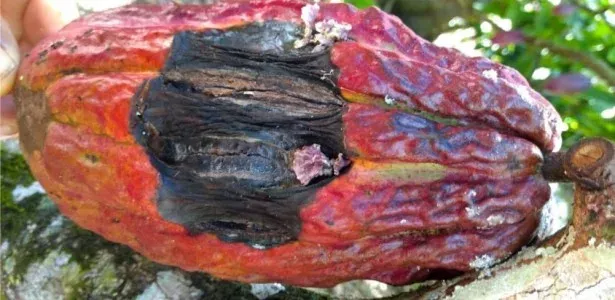
Cacao pods are also severely affected; young pods become distorted, necrotic, and turn black before hardening, eventually becoming dry and brittle while still attached to the tree.
A white or greyish fungal mycelium often appears on the surface of infected shoots and pods, marking the sporulation phase where the fungus prepares to release its spores.
Internally, the infected pods often show seeds fused into a mass covered with fungal threads, which prevents normal fermentation and renders the cacao beans completely useless for market.
Pathogen
The disease is caused by the fungus Moniliophthora perniciosa, a member of the basidiomycete group. This pathogen is highly specialized, targeting specifically cacao trees (Theobroma cacao) and related species within the Malvaceae family.
The fungus undergoes both asexual and sexual reproduction stages. It produces basidiospores which are easily dispersed by wind and splashing rainwater, facilitating the spread across large plantation areas.
The pathogen enters the host plant through young meristematic tissues, such as developing buds or fresh wounds on the bark, establishing a systemic infection within the tree's vascular system.
Once inside, the mycelium proliferates, releasing fungal hormones and enzymes that alter the tree's normal growth patterns, causing uncontrolled cell division and deformation.
Unlike many other pathogens, Moniliophthora perniciosa can persist in dried, infected plant debris for extended periods, serving as a constant source of inoculum for subsequent seasons.
Conditions for development
The development of Witches broom is highly dependent on environmental conditions, specifically high humidity and consistent rainfall, which are essential for spore germination.
Temperatures ranging from +20°C to +25°C provide the optimal climate for the fungus to thrive and rapidly colonize the internal tissues of the cacao tree.
Dense plantation layouts, where airflow is restricted, create a moist microclimate that allows fungal spores to survive longer and increase the probability of successful infection.
Poor management practices, such as lack of regular canopy pruning, create a conducive environment where the disease can proliferate unnoticed until it reaches a severe stage.
The presence of abandoned or poorly maintained neighboring farms serves as a reservoir for the pathogen, allowing wind-borne spores to easily migrate to healthier plantations.
Why it matters
Witches broom is historically recognized as one of the most devastating diseases in cacao cultivation, capable of reducing harvest yields by up to 90% in susceptible regions.
The infection exhausts the tree's physiological resources, as the plant directs nutrients toward the growing pathological brooms instead of supporting healthy fruit production.
Systemic colonization of the tree often results in tree death, as the fungus disrupts vascular pathways and weakens the structural integrity of the branches over time.
The economic impact is massive, encompassing direct crop losses, increased labor costs for sanitation, and the potential need to abandon or replant entire areas.
For rural economies that depend on cacao production, the prevalence of this disease can lead to widespread financial instability and the loss of traditional livelihoods.
Protection
The most effective management strategy is rigorous and regular sanitation pruning, involving the careful removal and destruction of all infected tissues, including brooms and dry pods.
It is critical that all removed plant material is incinerated or buried deep in the soil, ensuring that the fungus does not have the opportunity to release spores into the atmosphere.
Breeding and utilizing resistant cacao varieties is the most sustainable long-term solution, with ongoing research focusing on genetic markers associated with natural disease resistance.
Good agricultural practices, such as maintaining appropriate plant spacing to improve canopy aeration and regular monitoring for early symptoms, are essential components of an IPM program.
While chemical fungicides have shown some efficacy in controlling the disease, their application is often costly and logistically challenging, making integrated biological and cultural control the preferred choice.
Discussion
No discussions yet — be the first.