
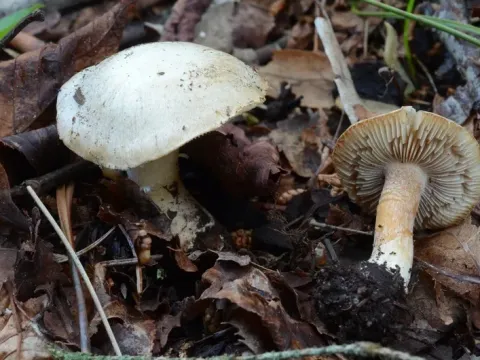
Inocybe queletii
Inocybe queletii
Inocybe queletii, commonly known as Quelet's fiber cap, is a mushroom species belonging to the Inocybaceae family. It is vital to state that this organism is not a plant pathogen and does not cause diseases in crops.
What the section contains
Inocybe queletii
Biologically, this fungus acts as a saprotroph or a mycorrhizal partner, typically found in woodland environments. It lacks the phytopathogenic traits required to infect living plant tissues.
The mycelium resides in the soil litter, establishing symbiotic relationships with tree roots. From an agronomic perspective, it poses no threat to agricultural productivity.
Morphologically, the fruit body features a conical to bell-shaped cap with a fibrous texture. Its coloration ranges from ochre to reddish-brown.
In scientific classification, it is considered a mycological subject rather than an agricultural pathogen studied in plant protection programs.
The presence of Inocybe queletii in an area is indicated by the appearance of its fruit bodies between summer and autumn. They typically grow in small groups.
Key visual characteristics include the fibrous cap surface and the close spacing of the gills. The stem often displays a mealy or powdery covering at the apex.
When damaged, the flesh may show slight color changes, a common diagnostic feature for the genus. This helps in field identification.
The fungus signifies active mycorrhizal activity in the soil, which is a hallmark of healthy forest or park ecosystems rich in organic matter.
No symptoms of disease such as wilting, necrosis, rot, or lesions are associated with this fungus on adjacent plants.
The development of Inocybe queletii requires high humidity levels and a substrate rich in decaying organic matter, such as forest leaf litter.
Moderate temperatures are required for fruit body formation. Excessive soil dryness inhibits the fungal activity and restricts the development of the mycelium.
The fungus prefers shaded areas with adequate soil aeration. It is rarely found in intensively cultivated agricultural lands where chemical treatments are frequent.
The life cycle is closely linked to tree roots, demonstrating a specific habitat requirement that is not present in typical mono-crop agricultural settings.
Seasonal patterns of growth depend on rainfall and ambient moisture, which regulate the sporulation phase of the fungus.
Inocybe queletii causes no harm to agricultural or ornamental crops. It is not an infectious agent and does not damage foliage, roots, or fruits.
The primary concern regarding this fungus is its toxicity to humans if accidentally ingested, as it contains muscarine alkaloids.
From a technical agronomic viewpoint, no control measures are required, as the organism has no negative impact on plant health.
The fungus does not compete for nutrients with crops. On the contrary, its mycorrhizal presence can be beneficial to the overall soil health of tree plantations.
Labeling this species as a plant disease is scientifically incorrect and does not align with established phytopathological documentation.
As this species is not a parasite, there are no control protocols developed or needed for its management in agricultural practice.
For ornamental gardens, manual removal of the fruit bodies is sufficient to prevent spore dispersal if the presence of mushrooms is deemed undesirable.
Preventative measures involve improving soil drainage and ensuring appropriate moisture management to limit conditions favorable for mushroom growth.
Always practice safety when handling unknown fungi to prevent accidental toxicity; the use of gloves is recommended during any cleanup.
The use of fungicides to manage Inocybe queletii is unnecessary and economically unjustified, given its status as a non-pathogen.